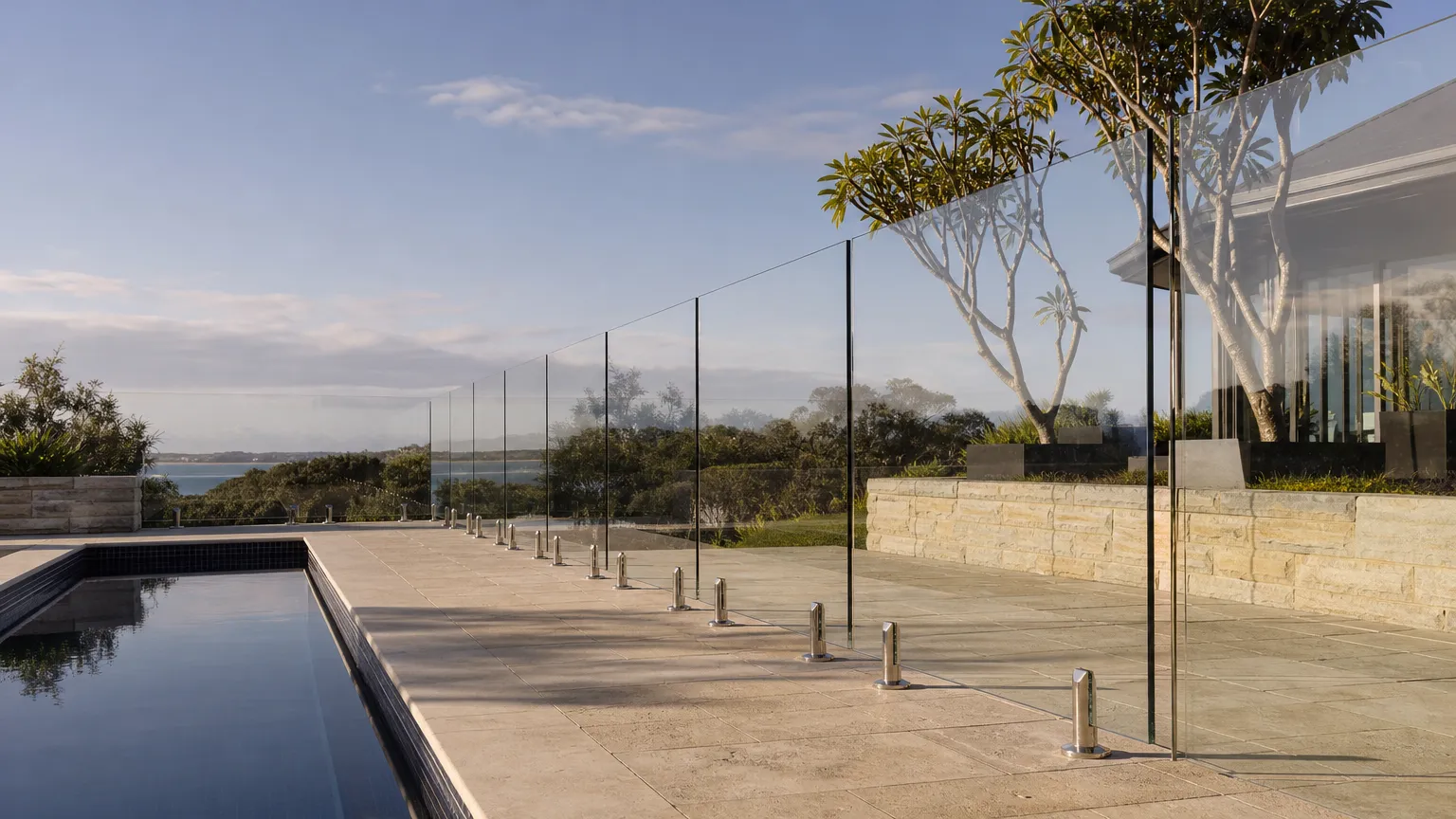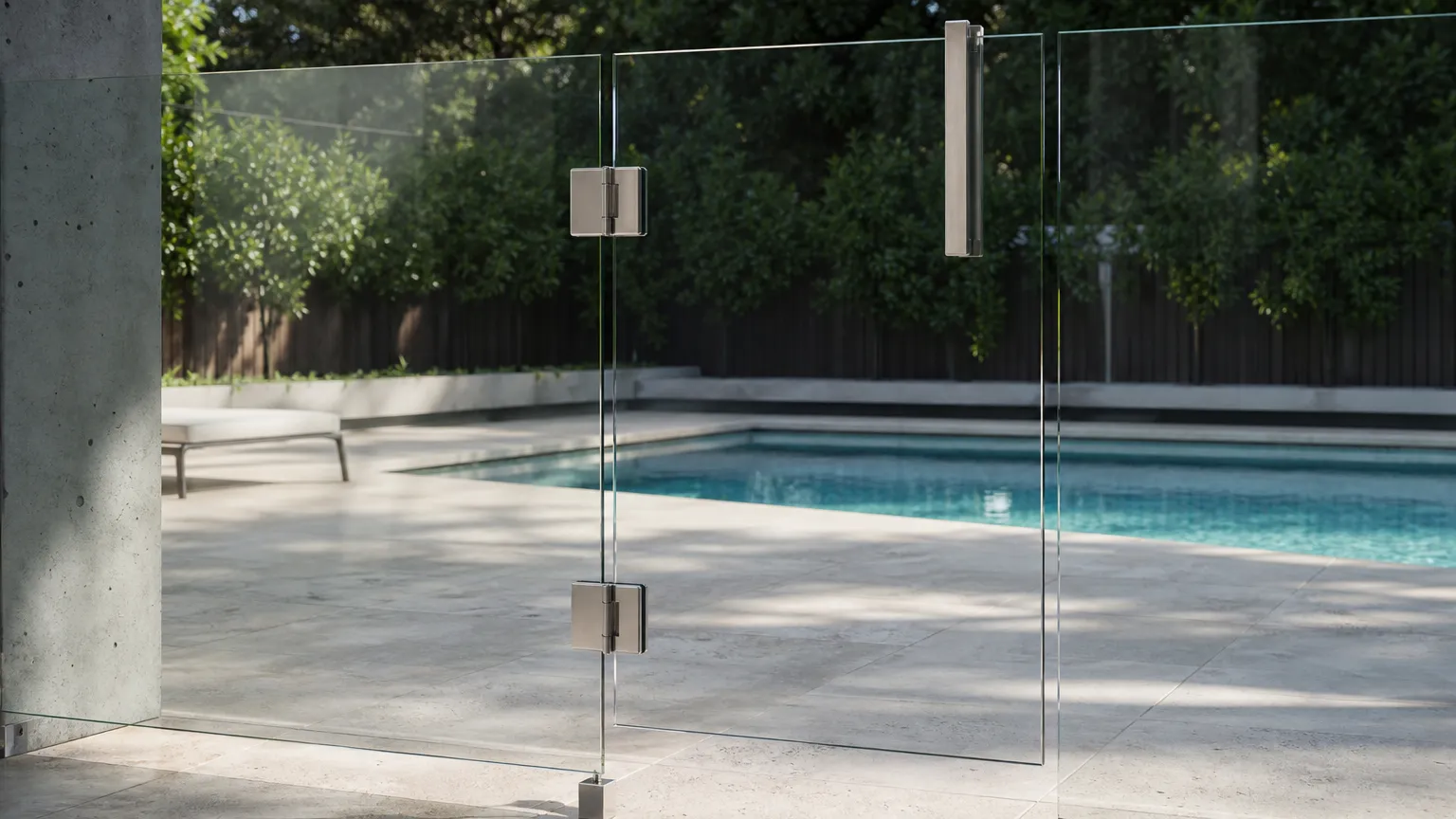
Start at the gate. It’s the only part of a pool fence that moves, and the part most likely to have changed since last summer. Hinges settle, latches drift out of line, and a gate that clicked shut every time in March can stop a few centimetres short by November. From there the walk takes you around the outside of the fence, along its base, over the glass itself, and finally indoors to the paperwork.
This is a homeowner’s check, not an inspection. The rules it refers to come from the NSW Government’s “Pool owner obligations” guidance (nsw.gov.au, checked October 2026), and only your council or an accredited private certifier can tell you whether a barrier complies.
Start at the gate
Open the gate as far as it goes and let go. It should swing shut and latch on its own, with no push. Then try it from halfway, and again from just ajar, because the last few degrees of travel are where a weak closer gives up. NSW requires pool gates to be self-closing and self-latching and to open away from the pool, so check the swing direction too if anything near the gate has been rebuilt.
If the gate stops short, the hinge tension usually needs adjusting. If it reaches the latch and bounces off, the latch and striker have moved out of line, often because a post or panel has shifted slightly. Latch height and shielding are set by AS 1926.1, so a replacement latch should be one made for pool gates, not a general hardware part. Frameless glass gates are heavy and their hinges carry that weight on a small fixing, so a gate that has started to drop needs attention before it gets worse.
Walk the outside of the fence
The non-climbable zone is a 900 mm arc measured from the top of the barrier down towards the ground on the outside, plus 300 mm on the inside of the pool area. Nothing a small child could climb should sit in it. Summer is when it fills up. The outdoor setting gets dragged into the shade, the esky goes against the glass, scooters get leaned on a panel, and pot plants creep in towards the fence line.
Walk the whole run on the outside and look at it the way a climber would. A planter, a wheelie bin, a tub of pool noodles, a low retaining wall, a tap or a branch that has grown over the top can each be a foothold. Glass gives a child very little to grip, so the weak spot is nearly always what has been put beside it.
NSW pool barrier
- Minimum height
- 1200 mm from finished ground level
- Gap under the barrier
- 100 mm or less
- Gaps between uprights
- 100 mm or less
- Non-climbable zone
- 900 mm arc outside, plus 300 mm inside
- Boundary fence as barrier
- 1800 mm high
- Gate
- Self-closing, self-latching, opens away from the pool
- Standard
- AS 1926.1-2012 for pools built after 1 May 2013 and any modified barrier
Source · NSW Government, Pool owner obligations
Measure along the base
Take a tape measure along the bottom of the fence. The gap under the barrier must be no more than 100 mm, and that gap changes over a year in ways people don’t notice. Mulch washes out of garden beds after heavy rain, lawn edges get dug back, and soil settles at the corners. Any of these can open a gap that was fine on installation day.
The opposite happens too. New turf, pebbles or a raised bed built up against the fence reduce its effective height, and the barrier has to stand at least 1200 mm above the finished ground outside it. Pay most attention where a garden bed meets the glass and where the fence crosses a slope.
Look over the glass and fittings
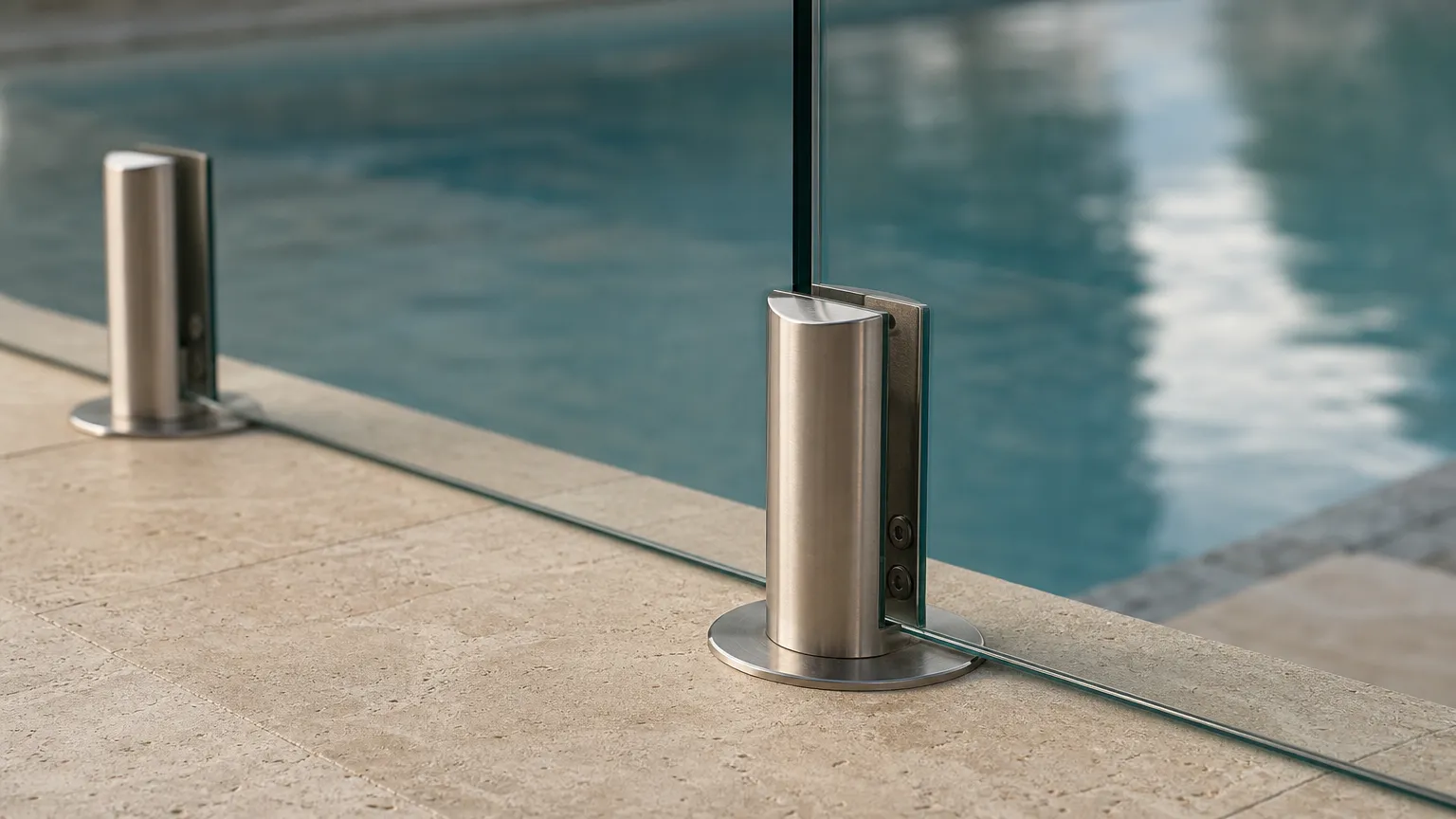
Sight along each panel from the end, then look down on it from above. You’re checking for chips on the edges, especially low down near the spigots and around the gate, and for any crack at all. Damaged toughened glass can fail without warning, so a chipped or cracked panel is a job for a professional, not something to keep an eye on. Each panel should still show its permanent safety mark.
Then hold each panel near the top and push gently. Nothing should move. A rocking panel or post means a fixing has worked loose or the ground under it has shifted. Brown staining or a white crust on the hardware is common near salt water and chlorinated pools, and a rinse with fresh water and a soft cloth slows it down.
Read the CPR sign
A CPR sign has to be displayed near the pool and be readable from 3 m away. Stand that far back and read it. The sign rules were updated on 1 September 2019, so replace an older or faded sign now.
Then the paperwork
Every pool and spa in NSW must be on the NSW Swimming Pool Register, recorded against the property address. The NSW Government is plain that registration is not a compliance check. If you’re planning to sell or lease over summer you’ll need a certificate as well, and a certificate of compliance lasts 3 years. Which certificate you need for a sale or a lease is covered in our guide to pool fence compliance when selling or leasing.
What you can sort out yourself
Moving furniture and pot plants, topping up a garden bed, rinsing hardware and replacing a faded sign are all owner jobs. Adjusting a self-closing hinge can be a small job too, if the hinge has an accessible adjuster and you’re confident with it.
Call an installer or a certifier for a cracked or chipped panel, a loose spigot or post, a latch that still won’t line up after adjustment, or any change to the barrier itself. Altering a barrier brings it under AS 1926.1-2012, and any earlier exemption ends. If you’re not sure whether something passes, your council or a private certifier can do a compliance inspection.
Book that work early, because a new panel has to be cut and toughened to size. If a gate or a section of fence needs replacing, our glass pool fencing page explains how a job runs, and you can ask for a free quote.