These are the questions people ask before they get a quote, answered briefly, with links to the longer guides where a short answer won’t do. Rules come from the NSW Government’s “Pool owner obligations” guidance (nsw.gov.au, checked October 2026). Prices come from published guides and carry their dates, because they move.
The fence itself
How does a glass pool fence stand up
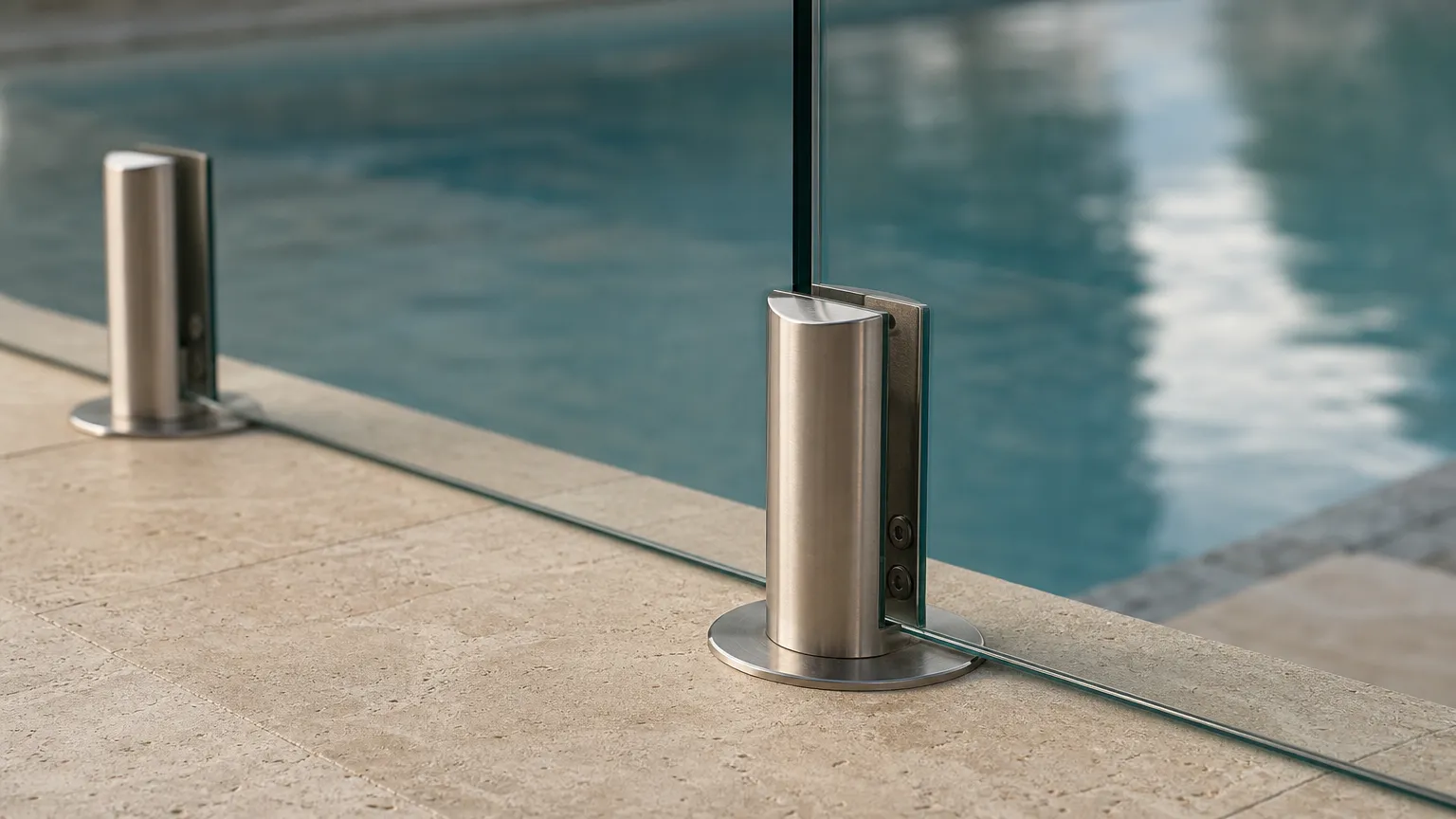
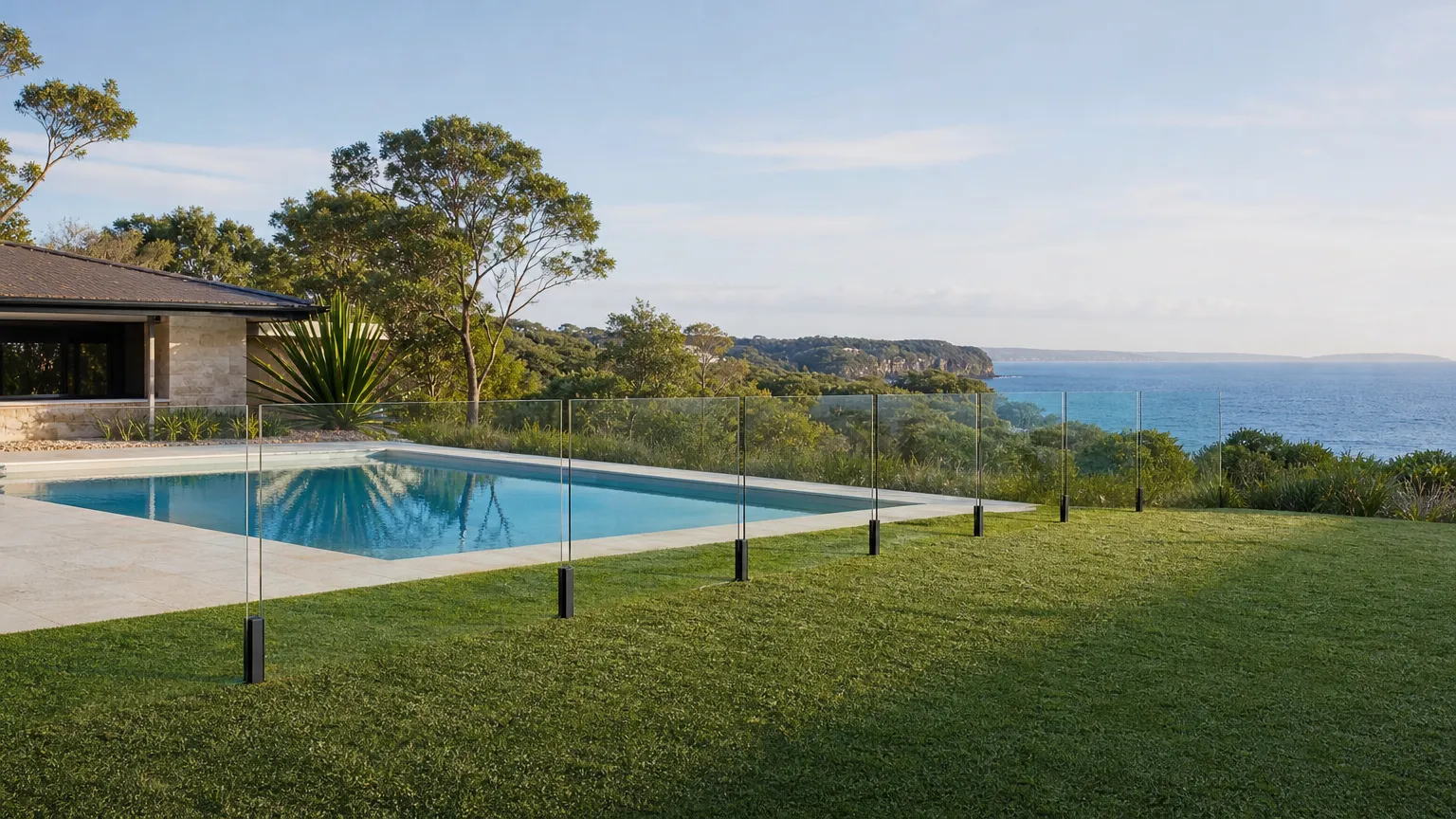
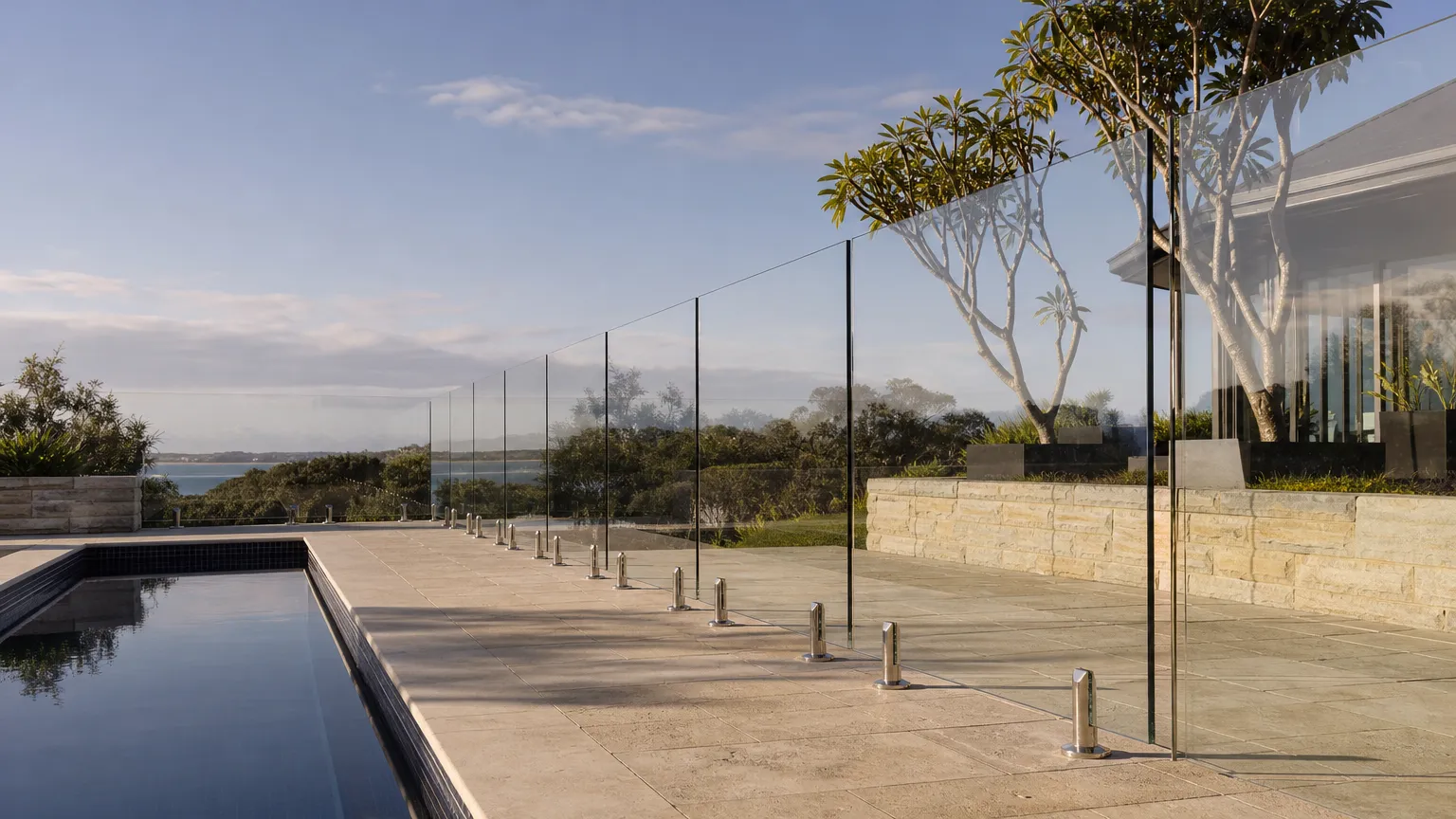
Each toughened panel is held at its base. In a frameless fence that’s done with small stainless spigots, either set into holes drilled in the concrete or bolted to the surface on a plate. In a semi-frameless fence, slim aluminium posts stand between the panels and clamp the glass. Some fences use a continuous channel along the base instead, and raised edges can take standoffs bolted to the face of the slab. The frameless and semi-frameless pages compare the two main types.
How thick is the glass
Thickness comes from the system design, not from a single legal figure. 12 mm toughened glass is the common Australian spec for frameless pool fencing, and other systems are designed around their own panels. Whatever the thickness, every panel is toughened safety glass carrying a permanent safety mark.
Will it crack in the heat
Toughened glass handles a Sydney summer and the odd knock from a pool toy. What it doesn’t like is edge damage. A chip on the edge, often from a whipper snipper, a dropped paver or a gate swung into something, weakens the panel, and a damaged toughened panel can fail completely. Have a chipped or cracked panel looked at rather than waiting. The guide to glass pool fence safety explains how toughened glass breaks.
Can I get tinted or frosted glass
Yes. Clear is the usual choice because it keeps the water visible from the house. Tints cut glare. Frosted glass gives privacy but hides the pool from whoever is supervising, so check with your council or a certifier first. The design options guide covers finishes and tints.
The rules
How high does it need to be, and what gaps are allowed
NSW pool barrier
- Minimum height
- 1200 mm from finished ground level
- Gap under the barrier
- 100 mm or less
- Gaps between uprights
- 100 mm or less
- Non-climbable zone
- 900 mm arc outside, plus 300 mm inside
- Boundary fence as barrier
- 1800 mm high
- Gate
- Self-closing, self-latching, opens away from the pool
- Standard
- AS 1926.1-2012 for pools built after 1 May 2013 and any modified barrier
Source · NSW Government, Pool owner obligations
At least 1200 mm from the finished ground level outside, with no more than 100 mm under the glass. A boundary fence used as part of the barrier has to be 1800 mm high. Glass has no vertical bars, so the gap check is mostly about the bottom of the panels, and the climbable zone around the fence usually matters more than the glass.
What do the gate rules say
The gate must close and latch by itself and open away from the pool. Latch height and shielding are set by AS 1926.1. Glass gates hang on pool-rated self-closing hinges, and they’re the part of the fence that needs checking most often. Test yours by opening it wide and letting go.
Which standard applies to my pool
It depends on when the pool was built. AS 1926-1986 may apply to pools built before 30 August 2008, AS 1926.1-2007 to pools built from 1 September 2008 to 30 April 2013, and AS 1926.1-2012 to pools built after 1 May 2013. Replace or alter the barrier and AS 1926.1-2012 applies, with earlier exemptions ending. A new glass fence counts as an alteration, so it’s built to the current standard.
Does the pool need to be registered
Yes. Every pool and spa in NSW has to be on the NSW Swimming Pool Register, and you need a CPR sign near the pool that can be read from 3 m away. Registration doesn’t mean the pool complies. Selling or leasing needs a certificate as well, and the selling and leasing guide sets out which one.
Do I need approval to install it
It depends on the site and the work, so ask your council or a private certifier before you order. They also carry out compliance inspections, and a certificate of compliance is valid for 3 years.
Money and upkeep
How much does it cost
Published price guides, installed
- Frameless, core-drilled spigots
- $400 to $700 per metre
- Frameless, base-plate spigots
- $420 to $750 per metre
- Frameless, side-fixed standoffs
- $550 to $900 per metre
- Semi-frameless, aluminium posts
- $280 to $450 per metre
- Frameless glass gate
- $900 to $1,800 each
- DIY kit, supply only
- From about $205 to $225 per metre
Source · Yakka Labour, Oct 2026 (installed); Glassfit Australia, Oct 2026 (kits). Sydney sits near the top of each range.
The installed figures in that panel come from Yakka Labour’s guide (1 October 2026, incl. GST), which notes that Sydney and Melbourne sit at the higher end. Service.com.au’s guide (updated 14 April 2026) is a little narrower, at $430 to $600 a metre for frameless installed, $300 to $430 for semi-frameless and $400 to $900 for a glass gate. Where a quote lands inside those ranges depends on the ground you’re fixing into, the number of gates and corners, any slope, and how easy it is to get glass onto the site.
Is a DIY kit cheaper
On materials, yes. Glassfit Australia (glassfit.com.au, checked October 2026) advertises kits from $205 a metre pin-fixed and $225 a metre face-fixed, supply only. You still do the drilling, setting and gate adjustment, and the finished fence still has to pass. The DIY kit page explains what’s involved.
How do I clean it
Fresh water and a soft cloth or squeegee. Skip abrasive pads and harsh cleaners, which scratch the glass and mark the fittings. Rinse the spigots and hinges as well, since salt and pool chemicals sit on them and shorten their life.
How long does it last
The glass lasts well as long as it isn’t chipped. The fittings are where wear shows, especially near salt water, so ask what grade of stainless steel you’re getting and keep it rinsed. Gate hinges and latches are the parts most likely to need adjusting or replacing over the years.
Going further
For planning a new fence, start with 10 things to know before installing glass pool fencing. For an existing fence before the warm weather, use the summer safety checklist. For how glass compares with aluminium, mesh and boundary fences, read glass vs other pool fence types. When you’re ready, ask for a free quote.