Most of what goes wrong with a new glass pool fence is decided before any glass is ordered. A gate in the wrong spot, a spigot drilled through waterproofing or a planter box left in the climbable zone is easy to fix on paper and expensive to fix once the panels have been toughened to size. These are the ten things to settle first, roughly in the order you’ll come across them.
The rules here come from the NSW Government’s “Pool owner obligations” guidance (nsw.gov.au, checked October 2026). Confirm them for your site with your council or a certifier.
Before anyone measures
1. Find out which standard applies
NSW applies different versions of the pool barrier standard depending on the pool’s age. AS 1926-1986 may apply to pools built before 30 August 2008, AS 1926.1-2007 to pools built from 1 September 2008 to 30 April 2013, and AS 1926.1-2012 to pools built after 1 May 2013. For a new fence the answer is simpler than that list suggests. Altering a barrier brings in AS 1926.1-2012 and ends earlier exemptions, so plan to meet the current standard whatever the pool’s age.
2. Ask about approvals
Whether you need approval depends on the site and the work. A fence that doubles as a boundary, or one going in as part of a bigger renovation, is worth raising with your council or a private certifier before you order. They’re also the people who will inspect it at the end.
3. Talk to the neighbours
If the pool area runs to a side or rear boundary, the boundary fence may form part of the barrier. That section then has to be 1800 mm high, and the neighbour’s side matters too, because a shed, a compost bin or a raised garden bed against their side of the fence can be a foothold. Shared fences are easier to sort out over the fence before the job than after it.
Getting the plan right
4. Settle the fence line
The fence line decides the panel count, the corners, and whether the fence clears paths, steps, the pool equipment and the house wall. Walk it with marking paint or a string line. Make sure you can still reach the pump and filter, that the fence doesn’t cut a path in half, and that there’s room to move furniture around it. An installer should measure and draw the layout before any glass is made.
5. Check what the glass fixes into
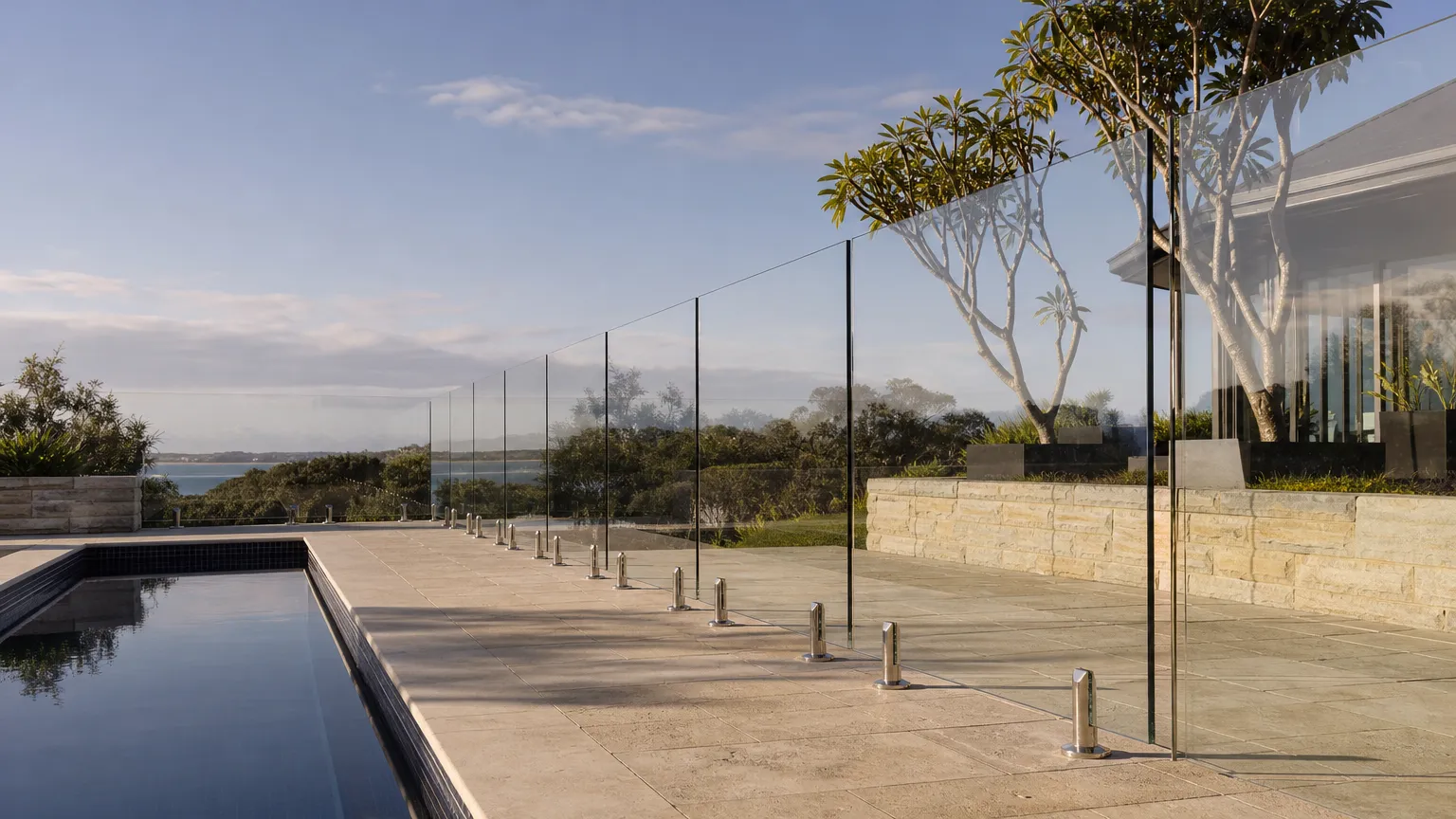
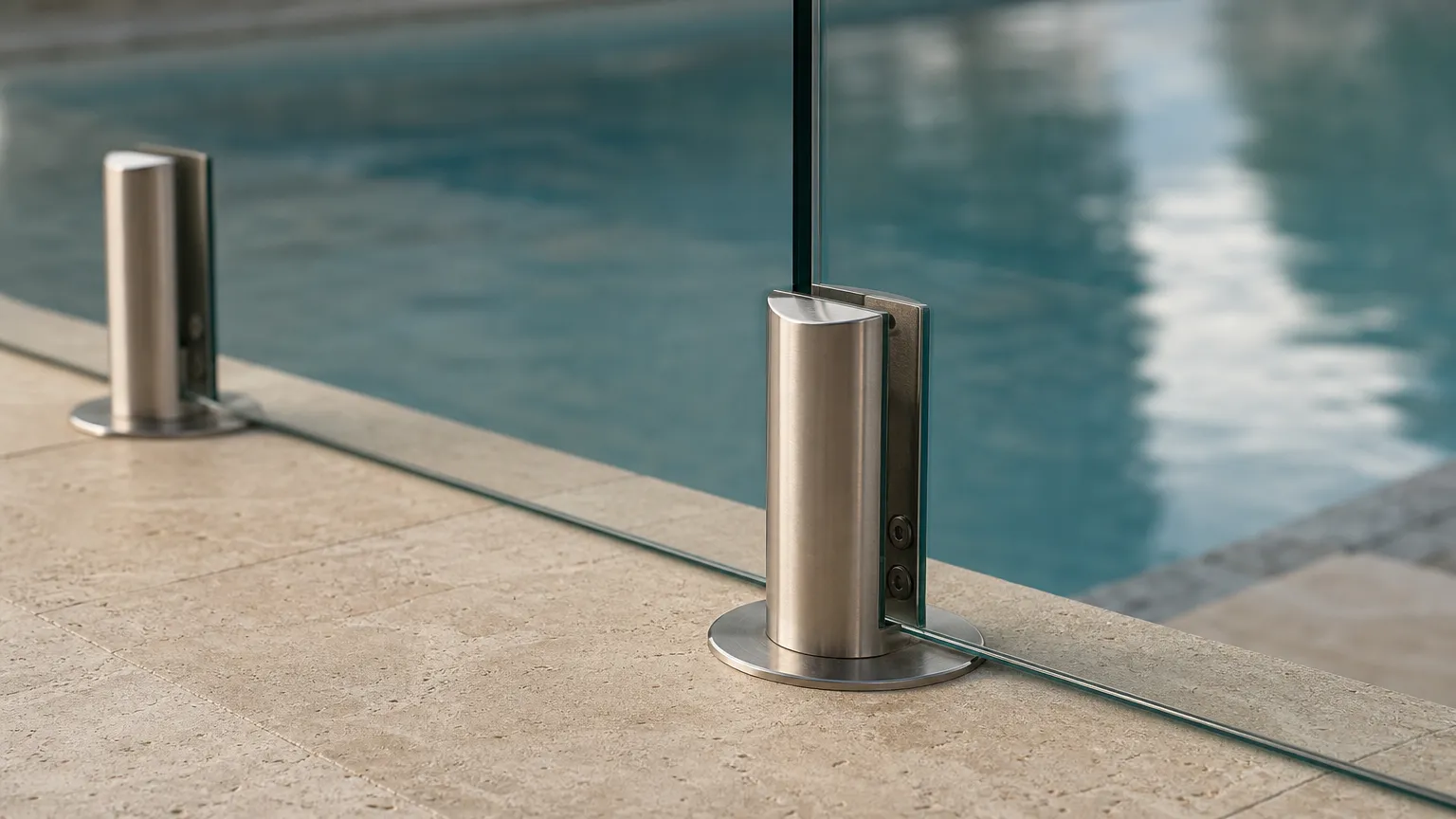
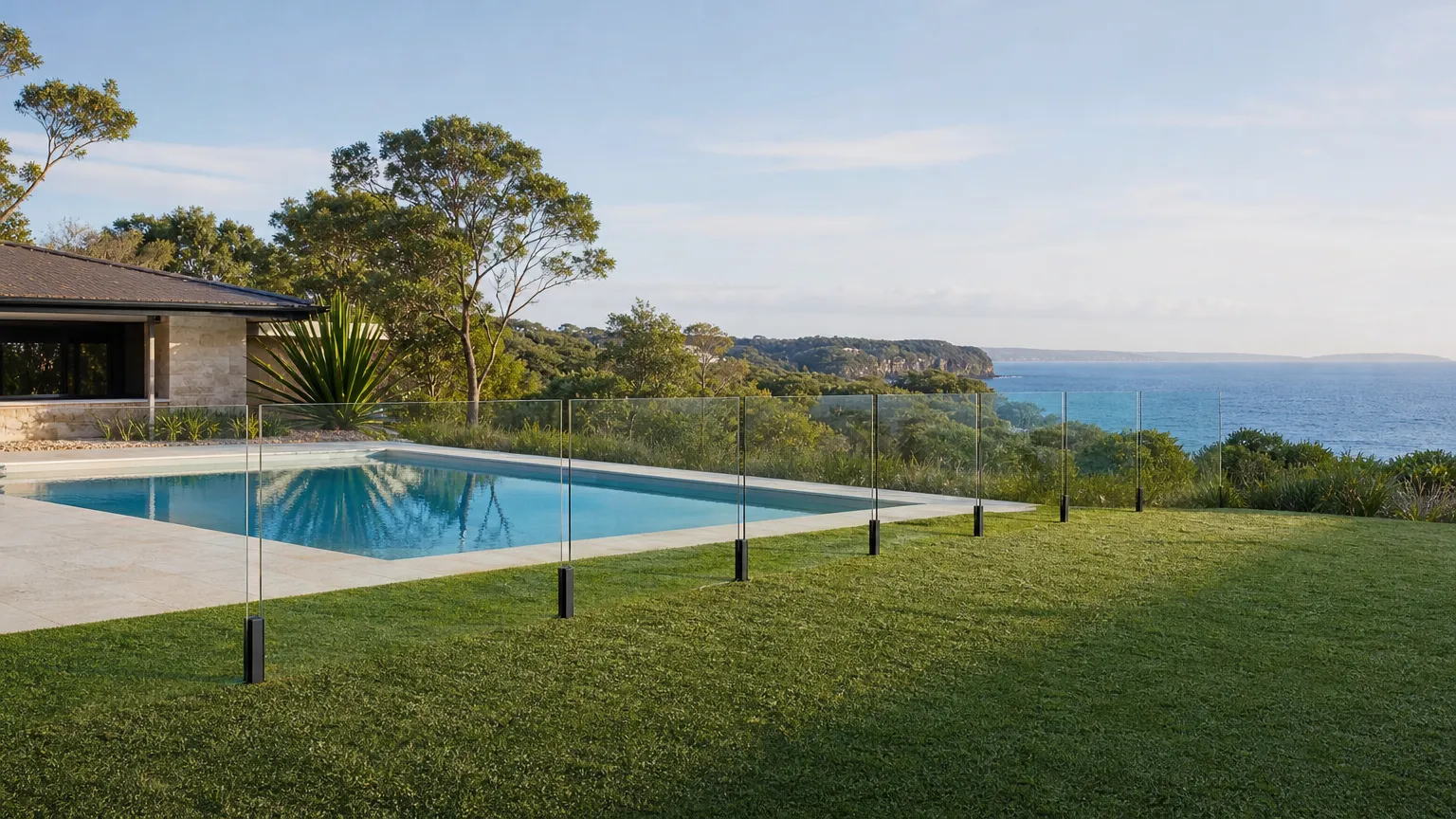
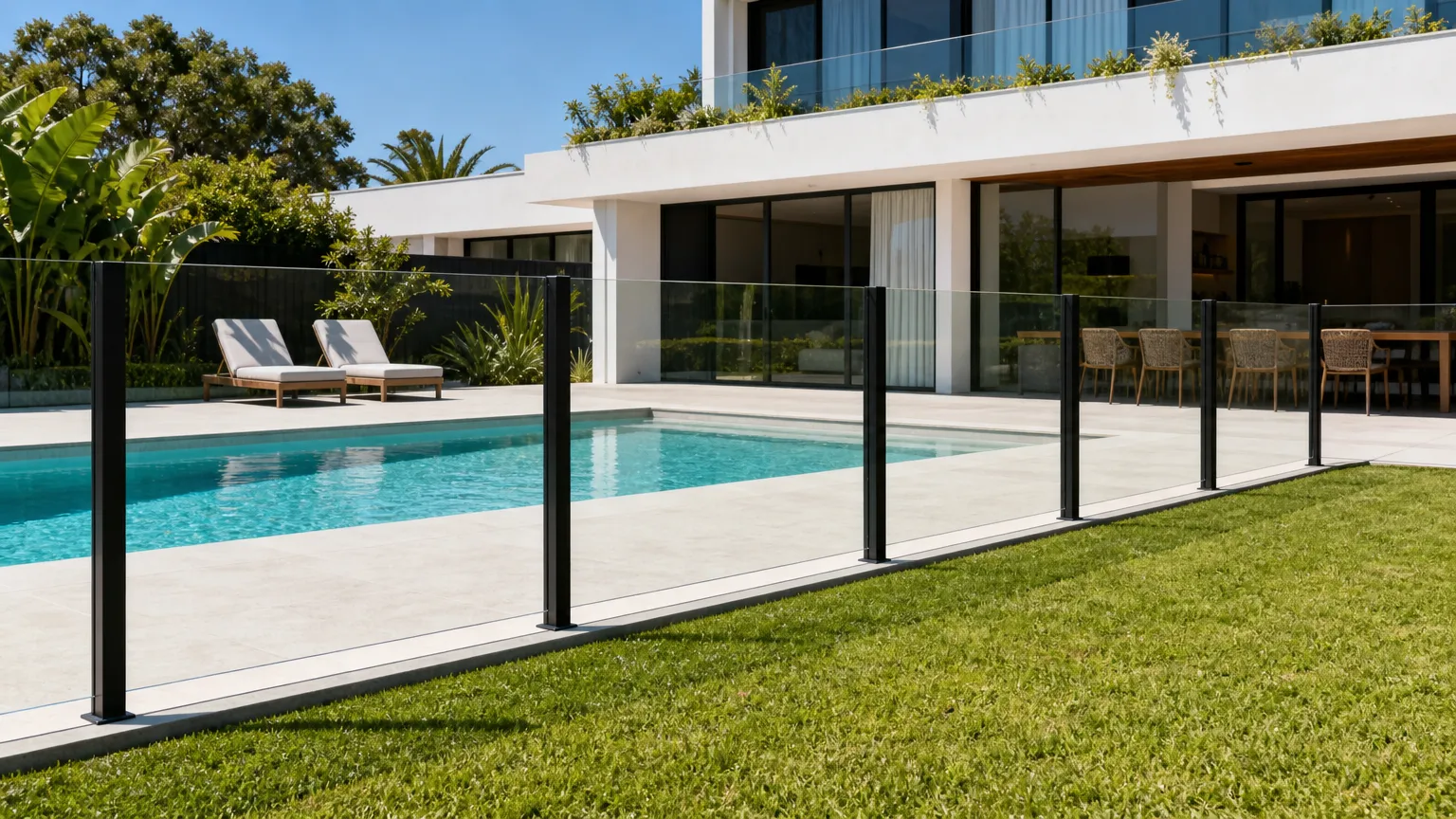
The surface under the fence decides how the glass is held. Solid concrete and thick stone suit core-drilled spigots. Pavers on sand, thin tiles and waterproofed slabs may not take a core drill, and usually suit base plates instead. Lawn suits semi-frameless posts concreted into footings. Yakka Labour’s guide (1 October 2026, incl. GST) puts frameless glass at $400 to $700 a metre on core-drilled spigots and $420 to $750 on base plates, so the ground changes the price as well as the method.
6. Put the gate on the path people use
The gate must be self-closing, self-latching and open away from the pool. Beyond that, put it where people actually walk between the house and the water, on level ground, where it won’t swing into a step or a path. Latch height and shielding are set by AS 1926.1, so the latch has to be pool-rated hardware.
7. Draw the climbable zone onto the plan
The non-climbable zone is a 900 mm arc outside the fence, measured from the top of the barrier, plus 300 mm inside the pool area. Mark it on the layout and look at what falls inside it, such as retaining walls, tree trunks, air-conditioning units, garden beds and built-in seats. Anything climbable in that zone has to move, or the fence line does. Ground that rises towards the fence matters too, because the barrier has to be at least 1200 mm above the finished ground outside it.
NSW pool barrier
- Minimum height
- 1200 mm from finished ground level
- Gap under the barrier
- 100 mm or less
- Gaps between uprights
- 100 mm or less
- Non-climbable zone
- 900 mm arc outside, plus 300 mm inside
- Boundary fence as barrier
- 1800 mm high
- Gate
- Self-closing, self-latching, opens away from the pool
- Standard
- AS 1926.1-2012 for pools built after 1 May 2013 and any modified barrier
Source · NSW Government, Pool owner obligations
Before you sign the quote
8. Think about water
Water that sits against the base of the fence stains the glass, corrodes fittings and makes pavers slippery. The ground should fall away from the fence line, and new fixings shouldn’t puncture the waterproofing around the pool. Garden beds next to the fence wash out over time, so check that the gap under the panels will stay at 100 mm or less once mulch and soil settle.
9. Match the hardware to the site
Glass outlasts the metal holding it. Spigots, hinges and latches near the coast or beside a saltwater pool face a harsher life than those inland, so ask what grade of stainless steel is being supplied and how it should be cleaned. Ask about the glass spec as well. 12 mm toughened is the common frameless spec in Australia, but the engineered system sets the thickness, and every panel should carry a permanent safety mark.
10. Budget from published figures, then plan the sign-off
Published price guides, installed
- Frameless, core-drilled spigots
- $400 to $700 per metre
- Frameless, base-plate spigots
- $420 to $750 per metre
- Frameless, side-fixed standoffs
- $550 to $900 per metre
- Semi-frameless, aluminium posts
- $280 to $450 per metre
- Frameless glass gate
- $900 to $1,800 each
- DIY kit, supply only
- From about $205 to $225 per metre
Source · Yakka Labour, Oct 2026 (installed); Glassfit Australia, Oct 2026 (kits). Sydney sits near the top of each range.
Those are third-party ranges, and Yakka Labour notes that Sydney and Melbourne sit at the higher end. Price the gate separately, and allow for anything the ground needs, such as replacing cracked pavers or rebuilding a garden edge.
Then plan the last step, which is certification. Every pool must be on the NSW Swimming Pool Register, and a compliance inspection by your council or a private certifier gives you a certificate of compliance, valid for 3 years. Ask your installer how they handle the inspection, and book the certifier early.
Once the fence line, ground and gate are settled, quotes become far easier to compare like for like. Our glass pool fencing page covers the systems, the frameless and semi-frameless pages compare them, and you can ask for a free quote when you’re ready.