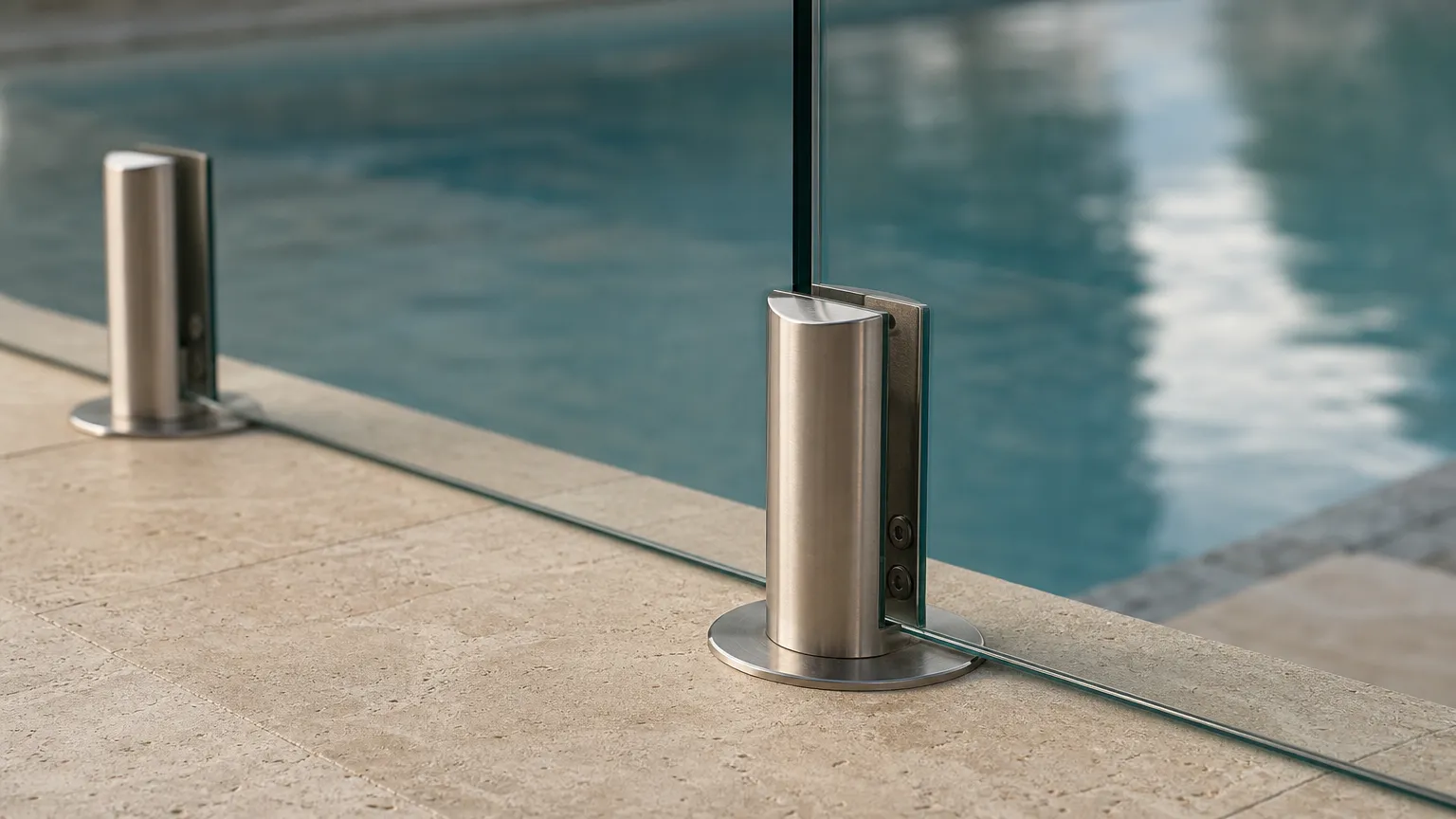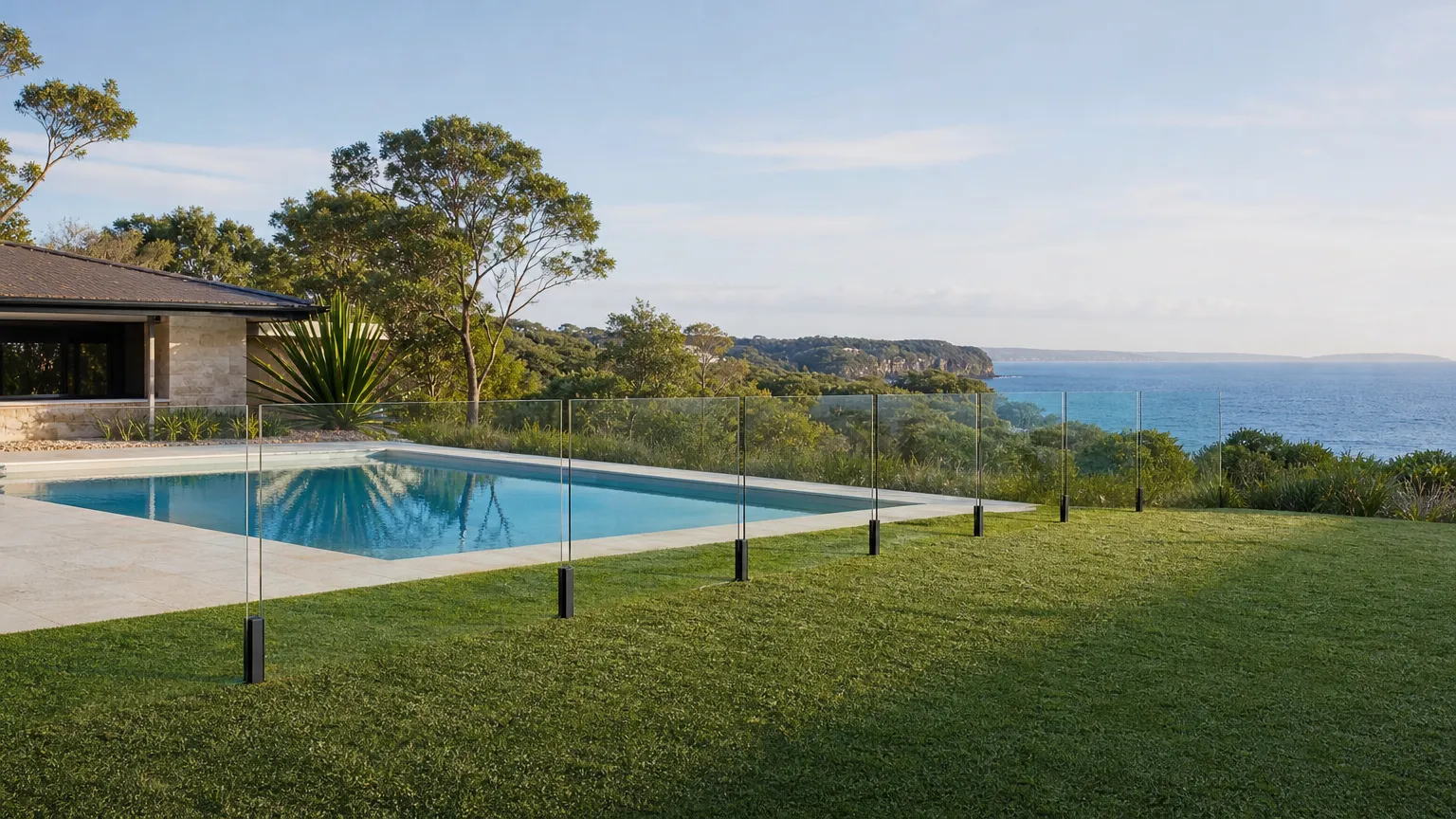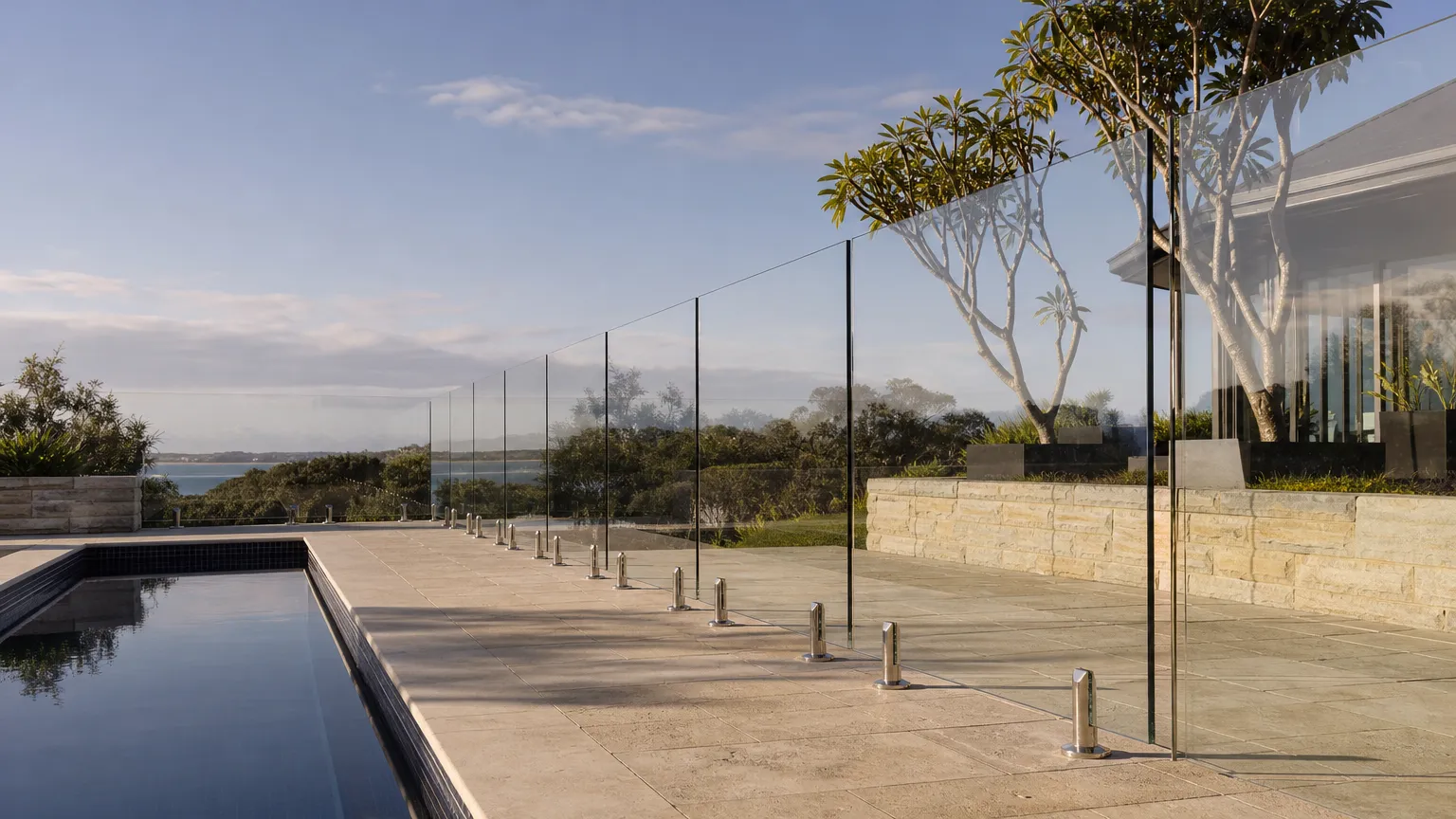
Most glass pool fences in Sydney are one of two things. Frameless fences hold each panel at the base with a small spigot and nothing else, so you look straight through to the water. Semi-frameless fences set the same glass between slim aluminium posts. They cost less and they’re easier on lawn edges and sloping blocks. Both can be fully compliant. The choice usually depends on what the fence is fixing into, how much view you want, and the budget.
Ways to hold the glass
- Core-drilled spigot
- Set into concrete or stone. Cleanest look, very rigid
- Base-plate spigot
- Bolted to the surface. Quicker, plate visible
- Channel
- Continuous aluminium channel, surface or recessed
- Standoff
- Bolted to the slab face or stringer. Keeps the floor clear
- Posts
- Slim aluminium posts between panels (semi-frameless)
Source · Common Australian systems
What the rules ask for
The fence is a safety barrier before it’s anything else, and NSW is specific about it. The barrier has to stand at least 1200 mm above the finished ground on the outside, with no more than 100 mm under the glass. Gates have to shut and latch on their own and swing away from the pool. Every pool and spa has to be on the NSW Swimming Pool Register, and selling or leasing the property needs the right pool certificate, usually a certificate of compliance.
NSW pool barrier
- Minimum height
- 1200 mm from finished ground level
- Gap under the barrier
- 100 mm or less
- Gaps between uprights
- 100 mm or less
- Non-climbable zone
- 900 mm arc outside, plus 300 mm inside
- Boundary fence as barrier
- 1800 mm high
- Gate
- Self-closing, self-latching, opens away from the pool
- Standard
- AS 1926.1-2012 for pools built after 1 May 2013 and any modified barrier
Source · NSW Government, Pool owner obligations
The standard that applies depends on your pool’s age, which catches people out. Replace an old aluminium fence with glass and the new barrier has to meet AS 1926.1-2012, even if the pool is decades old. Any exemption the old fence had ends with it.
Where fences actually fail
Glass is hard to climb, so the glass is rarely the problem. The trouble is usually whatever sits beside it. A pot plant, a pool pump cover, a retaining wall, a tap or an overhanging branch inside the 900 mm zone outside the fence gives a child a way up. When we set out a fence line, we look at the landscaping at the same time and tell you what has to move.
What it costs
These are third-party published ranges, not our prices. Your quote depends on the ground, the levels, the number of gates and how easy the site is to get glass into.
Published price guides, installed
- Frameless, core-drilled spigots
- $400 to $700 per metre
- Frameless, base-plate spigots
- $420 to $750 per metre
- Frameless, side-fixed standoffs
- $550 to $900 per metre
- Semi-frameless, aluminium posts
- $280 to $450 per metre
- Frameless glass gate
- $900 to $1,800 each
- DIY kit, supply only
- From about $205 to $225 per metre
Source · Yakka Labour, Oct 2026 (installed); Glassfit Australia, Oct 2026 (kits). Sydney sits near the top of each range.
A few things push a Sydney quote towards the top of the range. Core-drilling sandstone or thick concrete takes longer than bolting down base plates. Stepped panels on a slope have to be cut to size. Coastal sites from Manly to Cronulla are worth fitting with duplex or marine-grade stainless, which resists salt far better than lower grades. And twelve-millimetre panels carried through a narrow side passage add labour.
Frameless or semi-frameless
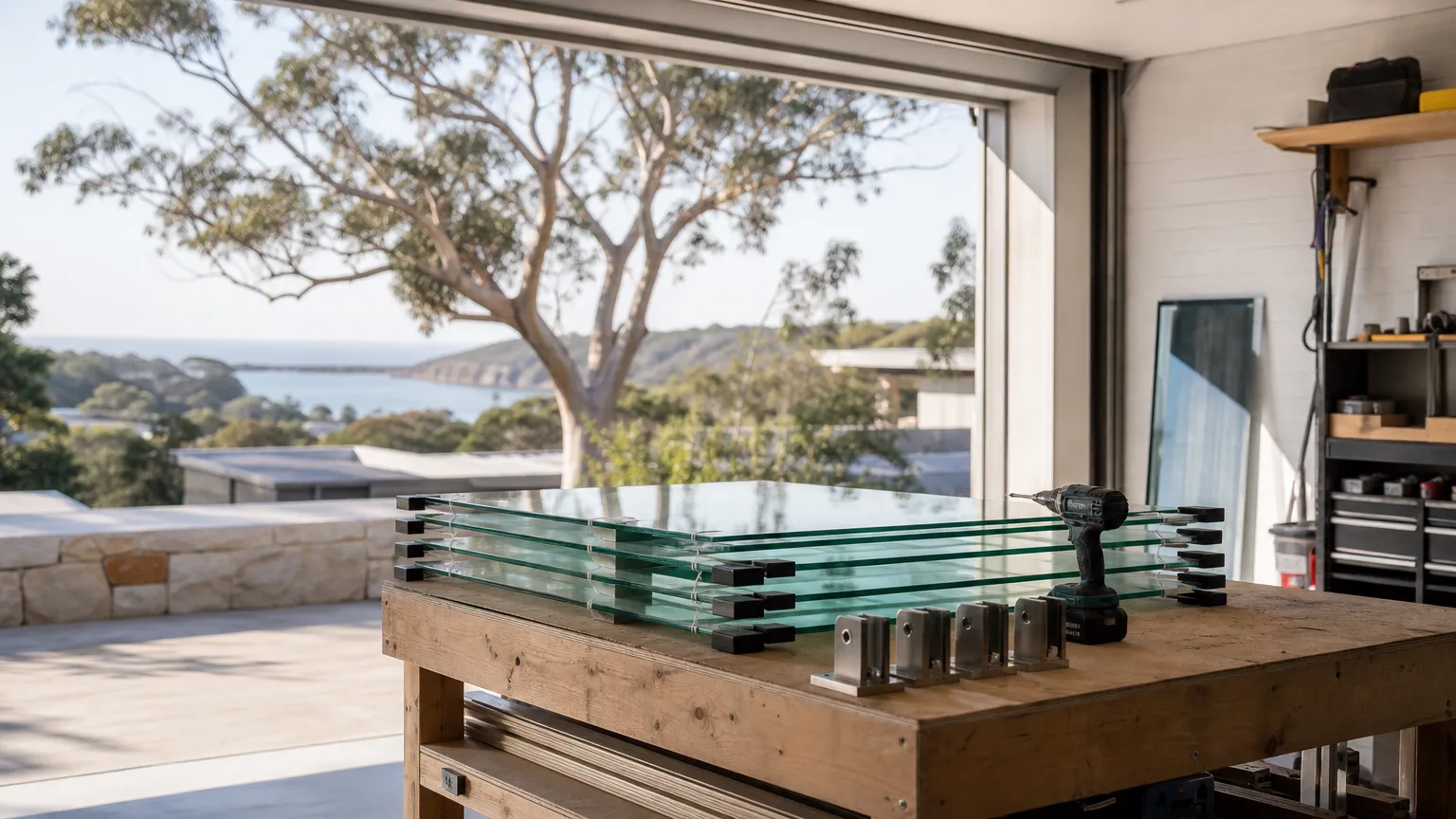
If the pool sits in pavers or concrete and you want the view, frameless on core-drilled spigots is the usual answer. If the fence crosses a lawn, or the block falls away, semi-frameless posts concreted into footings are simpler and cheaper. Elevated pools and deck edges can take side-fixed glass on standoffs, which keeps the deck clear but needs engineering for the height of the fall. If you’re handy, a DIY kit saves the labour, though the finished fence still has to pass.
How a job runs
We start with the fence line, the levels, what the glass is fixing into and where the gates go. Standard panels cover most runs, and anything odd is measured for custom glass, which is toughened to order. On site, the spigots or channel go in first, then the panels are set and plumbed, then the gate is hung and the latch adjusted. Before we leave, the gate has to swing shut and latch from any open position, every gap is checked, and the zone outside the fence is clear.
We quote across Sydney and up to about 50 km out, including the Northern Beaches, Mosman, St Ives and the upper North Shore, and Cronulla and the Sutherland Shire.