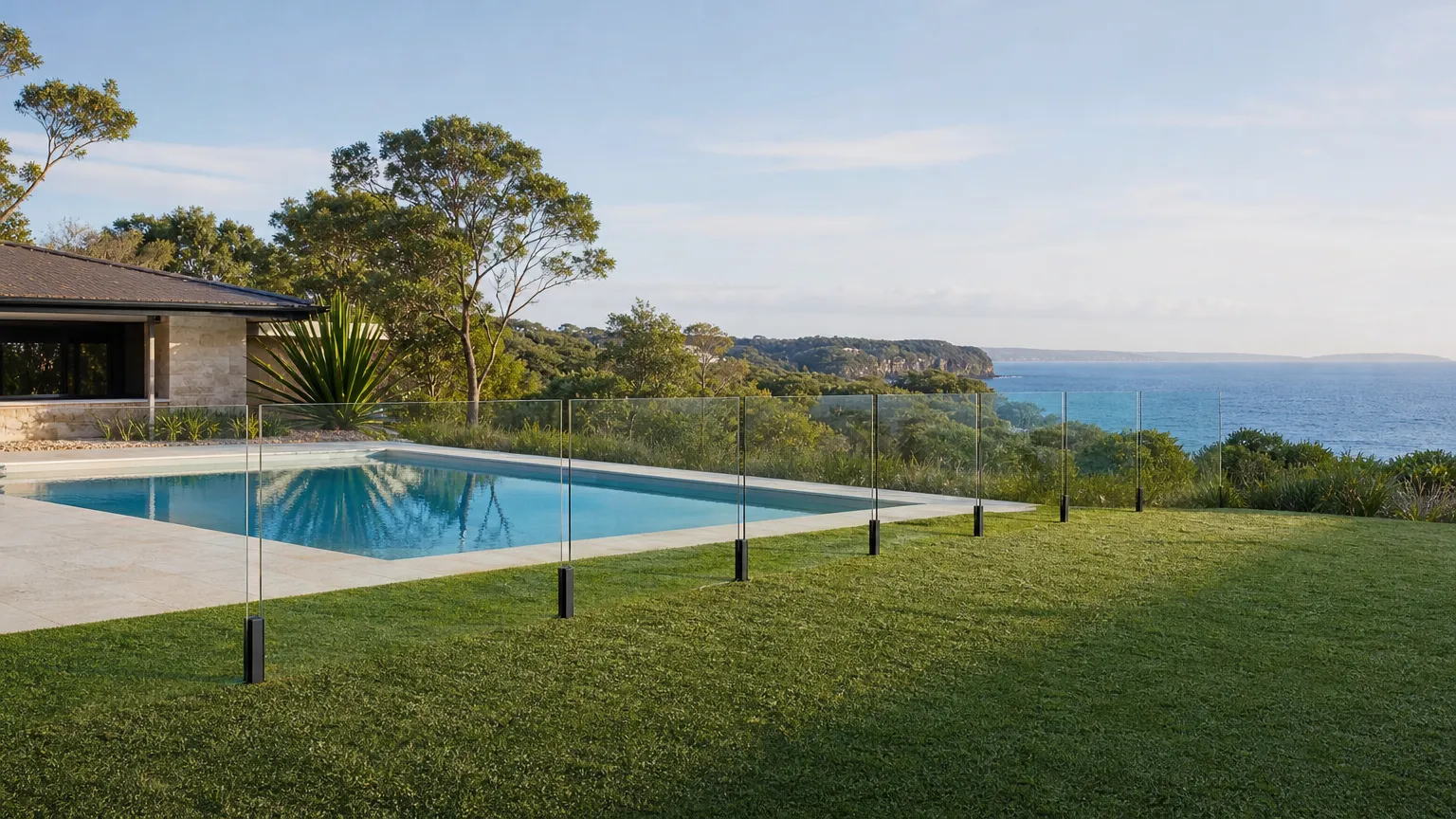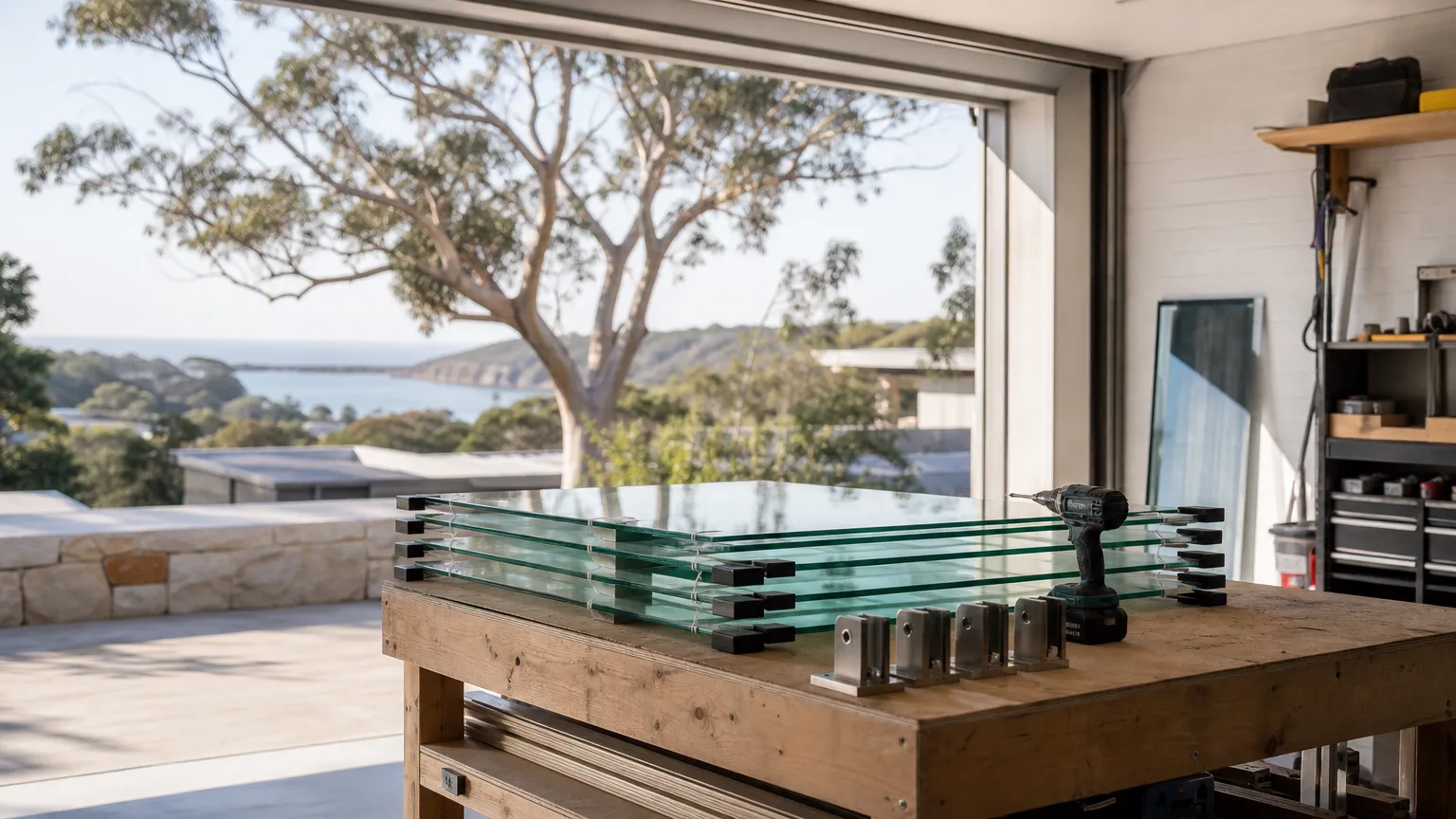
Take away the posts and the top rail, and all that holds a frameless fence up is what’s at the bottom of each panel. That fitting decides how the fence looks, how rigid it is, and how much of the price goes on labour. The glass itself is usually 12 mm toughened safety glass, set at least 1200 mm above the finished ground and carrying a permanent safety mark.
What the glass stands on
Ways to hold the glass
- Core-drilled spigot
- Set into concrete or stone. Cleanest look, very rigid
- Base-plate spigot
- Bolted to the surface. Quicker, plate visible
- Channel
- Continuous aluminium channel, surface or recessed
- Standoff
- Bolted to the slab face or stringer. Keeps the floor clear
- Posts
- Slim aluminium posts between panels (semi-frameless)
Source · Common Australian systems
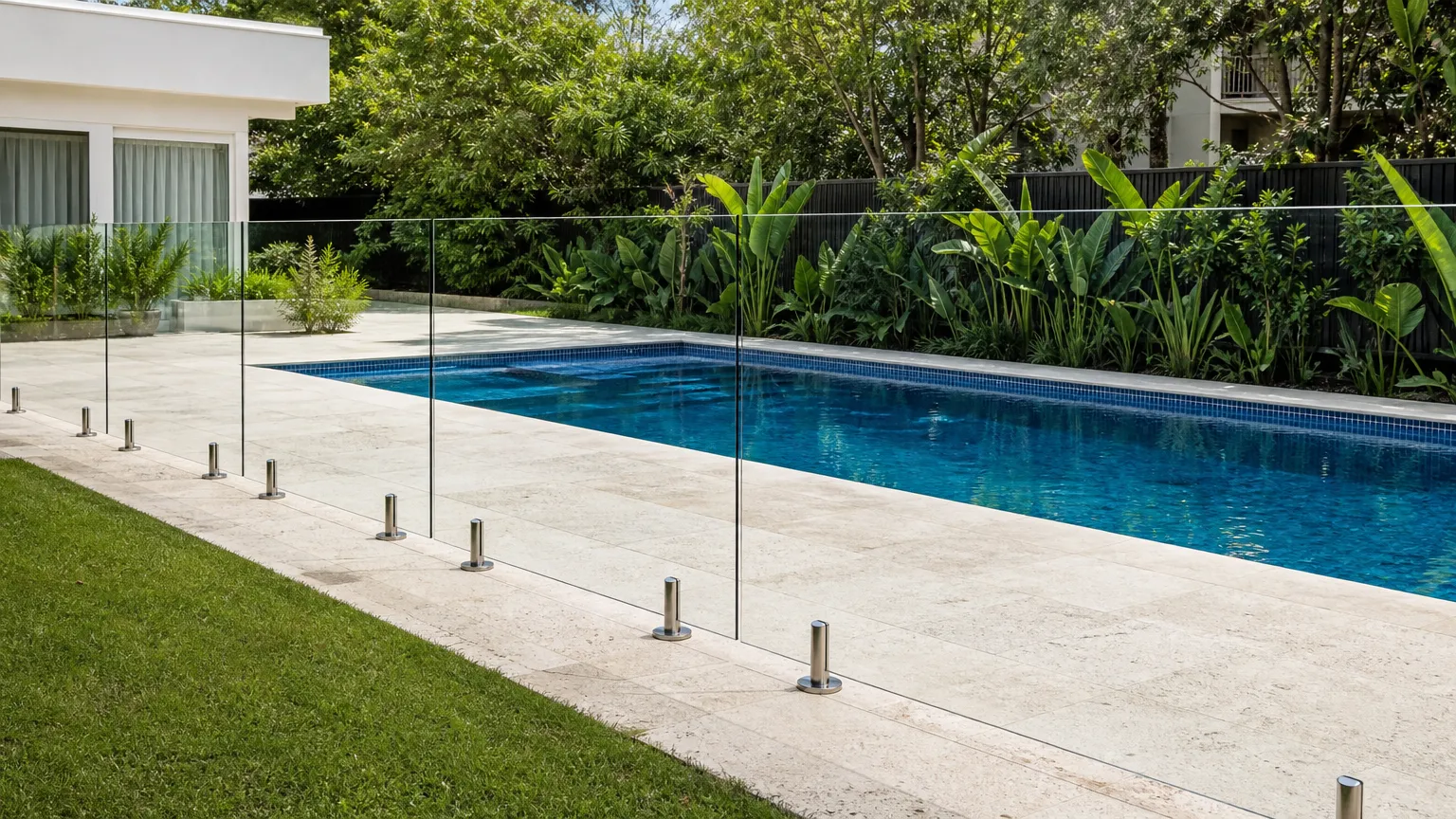
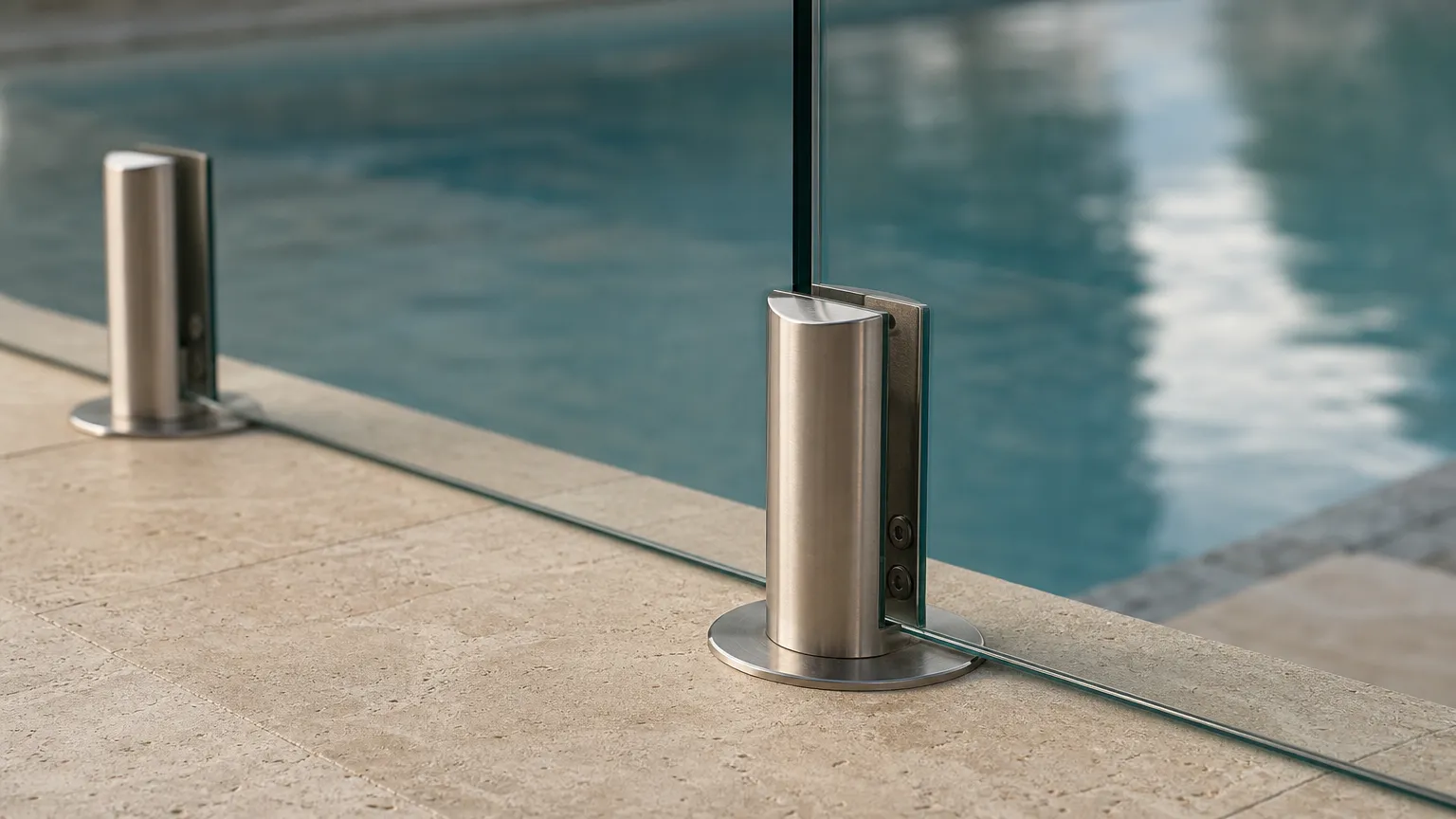
Core-drilled spigots are what most people picture. A hole is drilled into the slab or the stone coping, the spigot is set in grout or epoxy, and only a small round cover shows at the base. They’re very stiff once set. They need enough depth of concrete, and drilling sandstone or thick slab takes time.
Base-plate spigots bolt down through a flat plate. They go in faster, and they’re the safer choice over a slab with pipes or cables running through it, though you can see the plate and its bolts.
A channel is a continuous aluminium section, either sitting on the surface or recessed into the slab. Recessed, the glass seems to come straight out of the ground. It’s best planned before the pavers go down, because cutting a channel into finished pavers is slow.
Side-fixed standoffs bolt the glass to the face of a raised pool wall or a deck edge, so the top surface stays clear. Yakka Labour’s October 2026 guide puts them at about $550 to $900 a metre installed, the most expensive of the four.
The gate
A frameless gate hangs on glass-to-glass hinges or from a hinge panel, and closes onto a magnetic latch. It has to self-close and self-latch from any open position, and it has to open away from the pool. Latch height and shielding are set by AS 1926.1. The closing speed and the latch are adjusted on site until the gate shuts every time from fully open and from just ajar.
Yakka Labour’s guide puts a frameless glass gate at $900 to $1,800, and Service.com.au’s April 2026 guide puts glass gates at $400 to $900. Most of that spread is in the hinges and the latch.
Prices and what moves them
For the panels, Yakka Labour lists about $400 to $700 a metre on core-drilled spigots and $420 to $750 on base plates, including GST. Service.com.au’s guide gives $430 to $600 a metre installed. Yakka Labour notes that Sydney sits towards the top of its ranges.
A quote climbs with stone that’s slow to drill, ground that steps down a slope, odd angles that need custom panels made to order, and side passages too narrow to carry glass through easily.
Coastal sites
Salt air and chlorinated water both attack stainless steel. On the coast, and around salt water pools, duplex or marine-grade stainless or powder-coated aluminium spigots hold up far better than the cheaper grades. A rinse with the hose now and then keeps them looking clean.
If your pool sits on a lawn rather than pavers, or the budget is tight, semi-frameless fencing is worth comparing. The full NSW rules are on the glass pool fencing page.