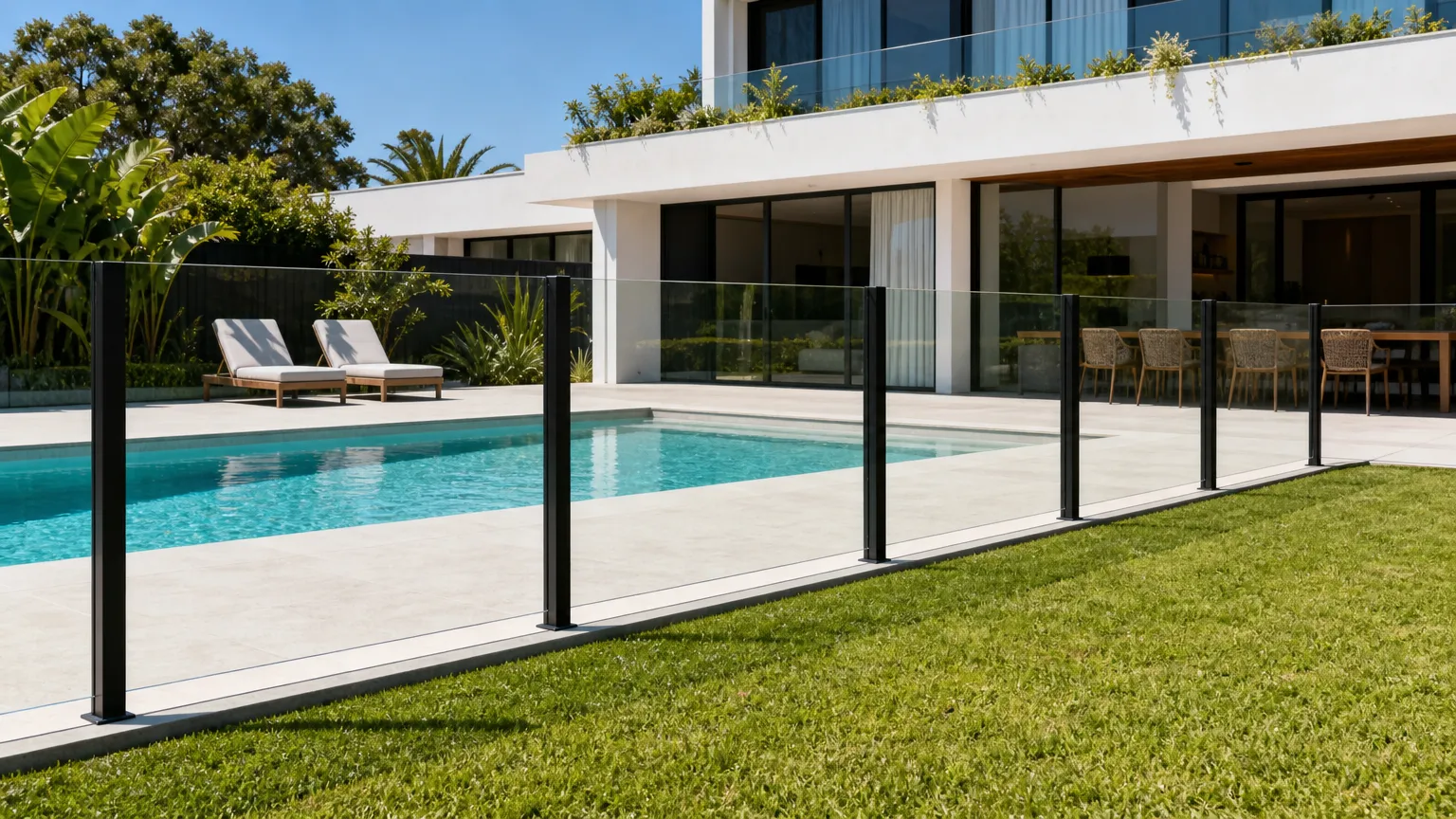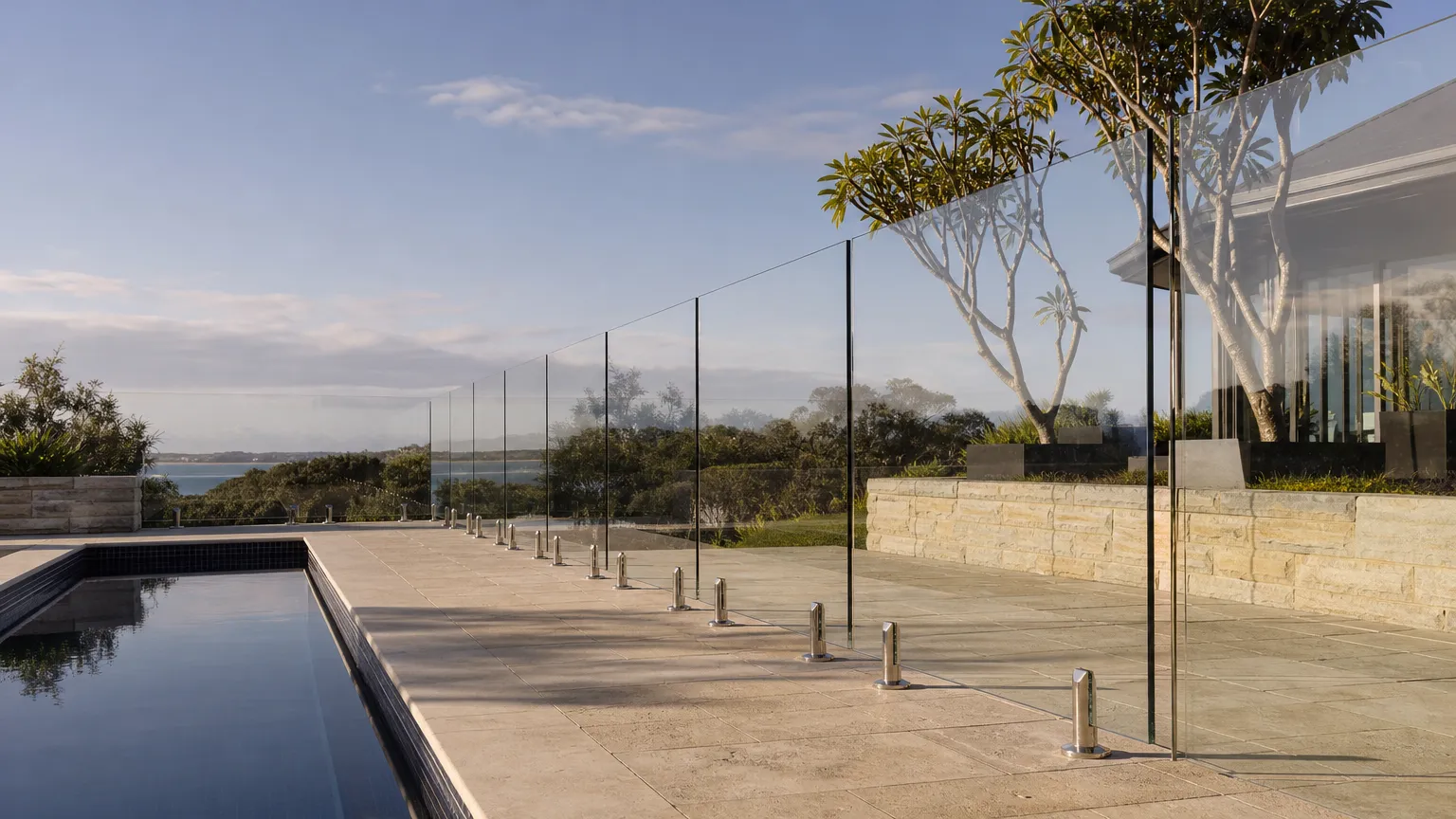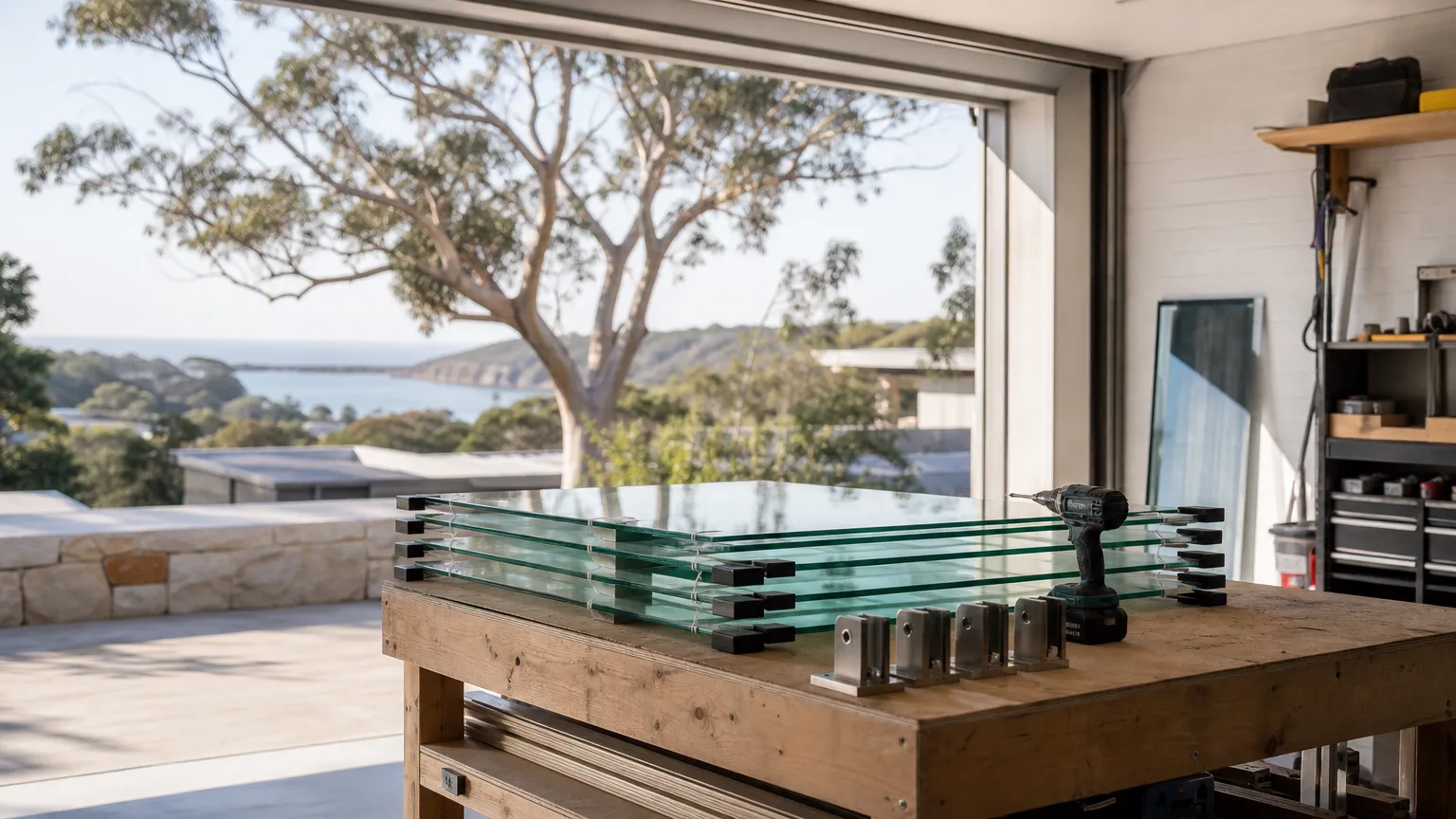
A kit makes sense if you’re comfortable with a core drill, a laser level and a long weekend of careful work, and you’d rather spend the labour money on something else. It makes less sense on a sloping block, a stone surround or a fence that has to tie into a boundary, where the set-out gets complicated. Either way the finished fence is held to exactly the same standard as one put in by an installer.
What comes in the box
A typical kit includes:
- toughened glass panels in standard widths, plus any custom panels you order
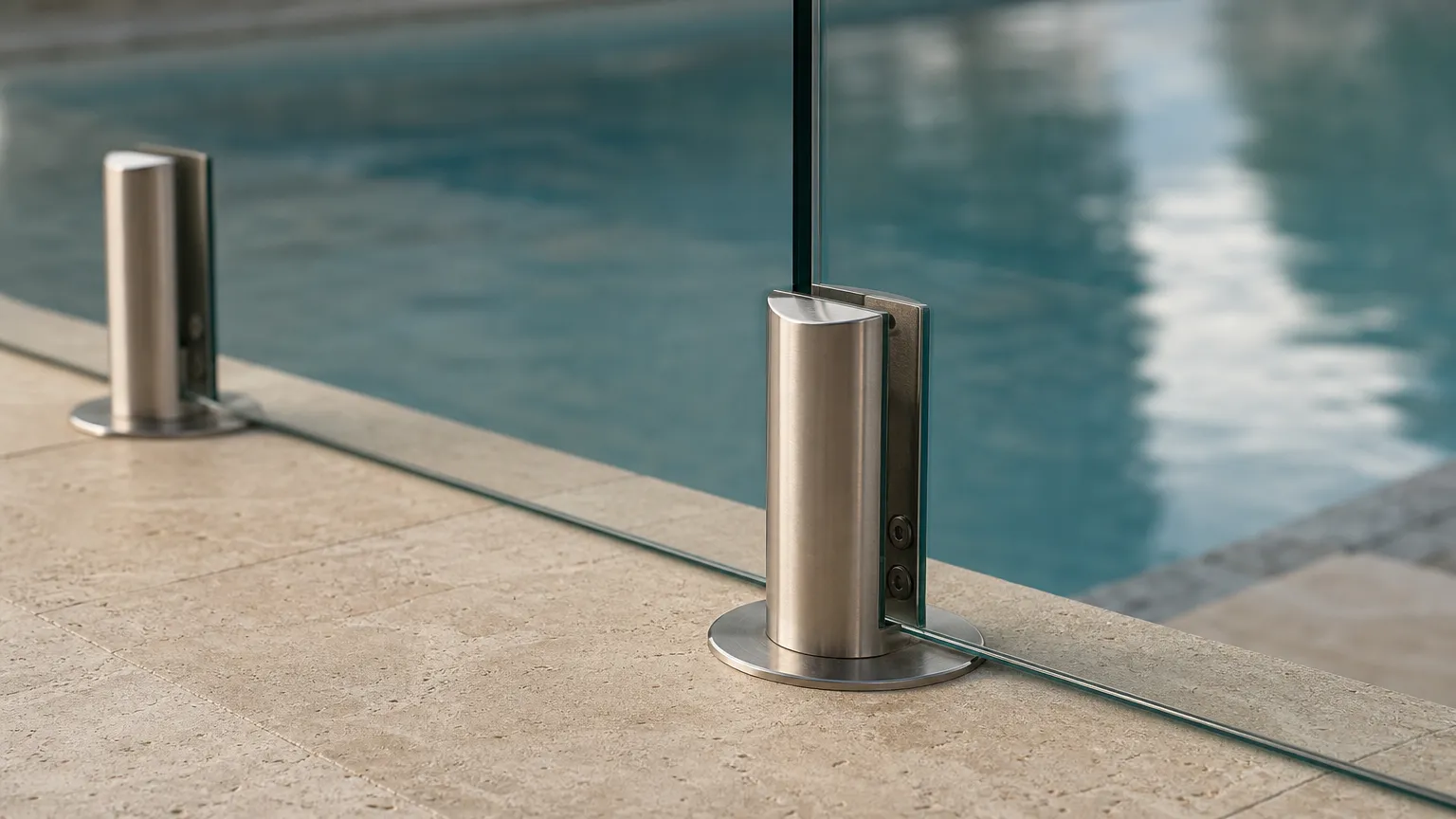
- spigots, core-drilled or base-plate, or standoff fittings for a face-fixed fence
- a glass gate with hinges and a self-closing latch
- rubber gaskets, caps and fixings
Check whether the gate hardware is adjustable and whether the latch comes with instructions for setting its height, because latch height and shielding are set by AS 1926.1.
What it costs
Glassfit Australia advertised kits from $205 a metre pin-fixed and from $225 a metre face-fixed when we checked in October 2026, supply only. Custom panels, the gate and delivery are added on top. For comparison, Yakka Labour’s October 2026 guide puts a supplied and installed frameless fence on core-drilled spigots at $400 to $700 a metre.
Where DIY fences go wrong
Most problems start before the first hole is drilled. Panels come in fixed widths, so the layout has to land the gaps evenly and put the gate where it can open away from the pool. Get the spigot positions out by a little and the error builds along the run until the last panel won’t fit. Toughened glass can’t be cut or trimmed to make up the difference.
Levels are the other trap. The 1200 mm height is measured from finished ground on the outside, and the gap under the glass can’t exceed 100 mm. On ground that falls away, both have to hold at every point, so check them at the low end of each panel as well as the high end.
The gate is the last thing fitted and the first thing an inspector tests. It has to swing shut and latch on its own from any open position, including from just ajar. Expect to adjust the hinges more than once.
Before you order
Measure the full run twice, mark the gate position, and note the surface the spigots will go into. If part of the fence is a boundary fence, that section has to be 1800 mm high. Read the NSW rules on the pool fencing page, and if you’re unsure which standard applies, ask your council or a private certifier first.
Getting it signed off
Registration and certificates
- Register
- Every pool and spa on the NSW Swimming Pool Register
- Selling
- Certificate of compliance, a recent occupation certificate, or a non-compliance certificate
- Leasing
- Certificate of compliance or occupation certificate
- Certificate lasts
- 3 years
- CPR sign
- Near the pool, readable from 3 m
Source · NSW Government, Pool owner obligations
Once the fence is up, a council or an accredited private certifier can inspect it and issue a certificate of compliance. It’s valid for 3 years. To lease the property you need one, or an occupation certificate, and a sale contract has to include one of the certificates above. The pool also has to be on the NSW Swimming Pool Register, though being registered doesn’t mean it complies.
If you’d rather hand over the drilling and the gate, the quote form works for supply and installation as well.