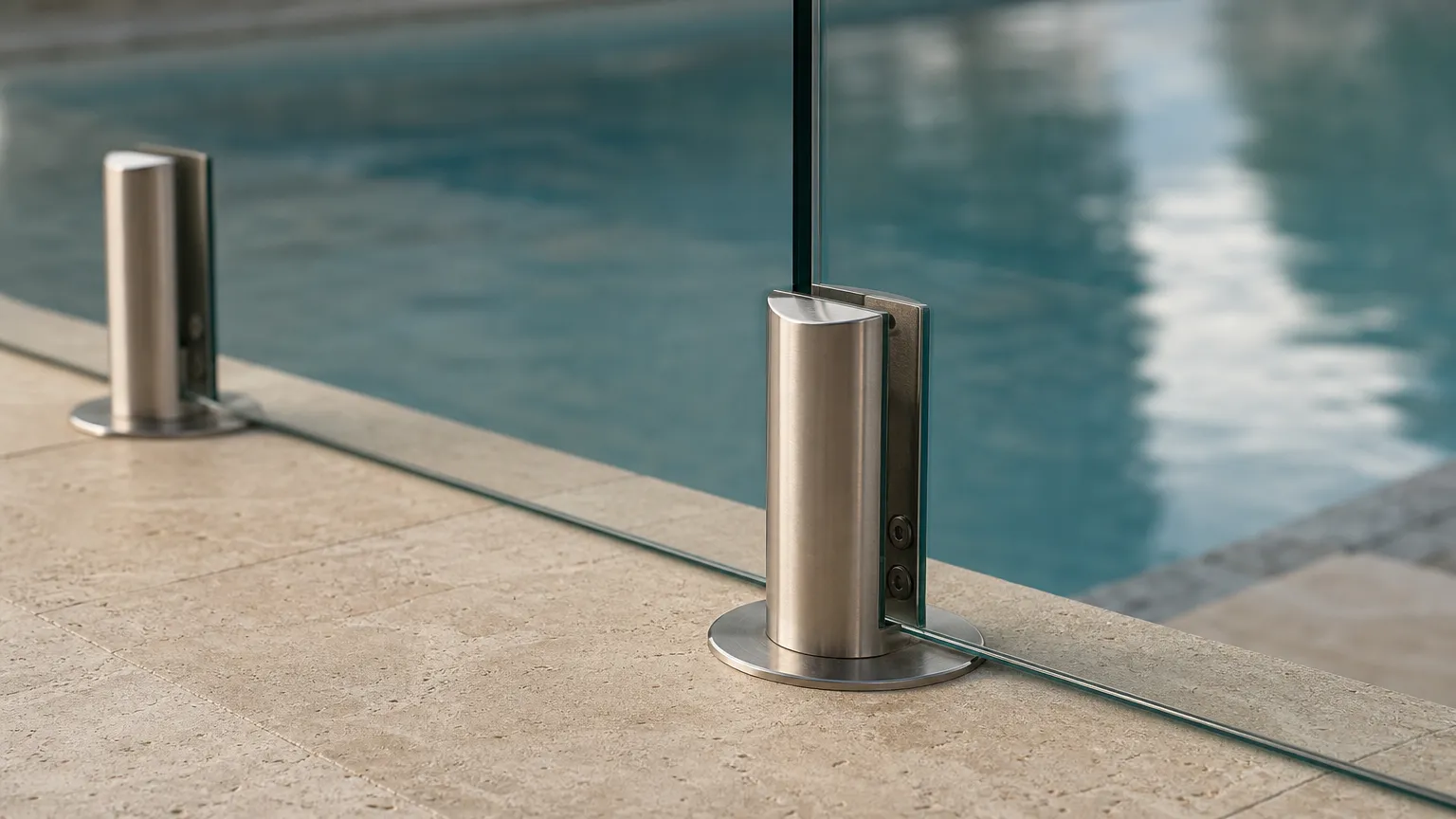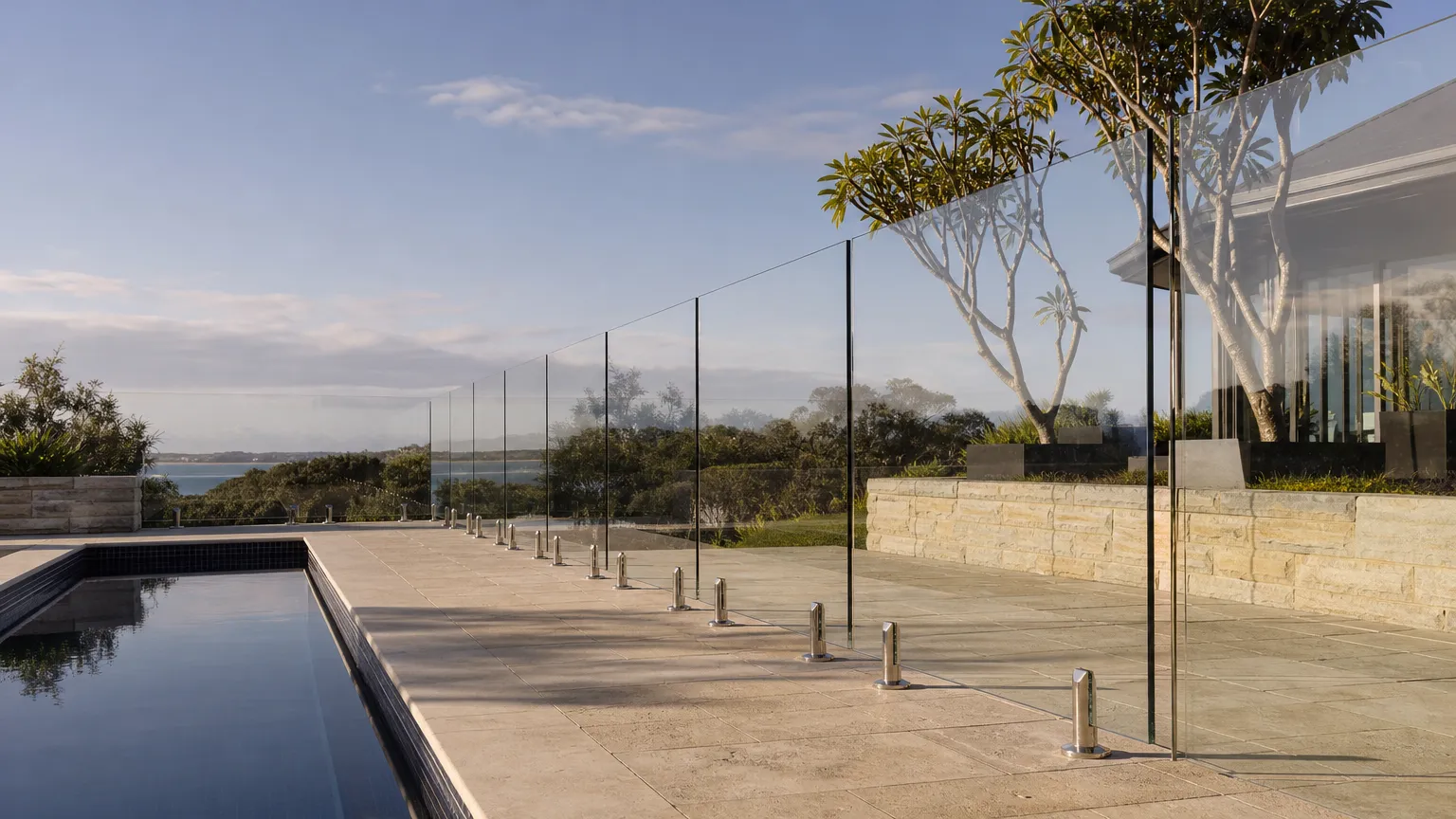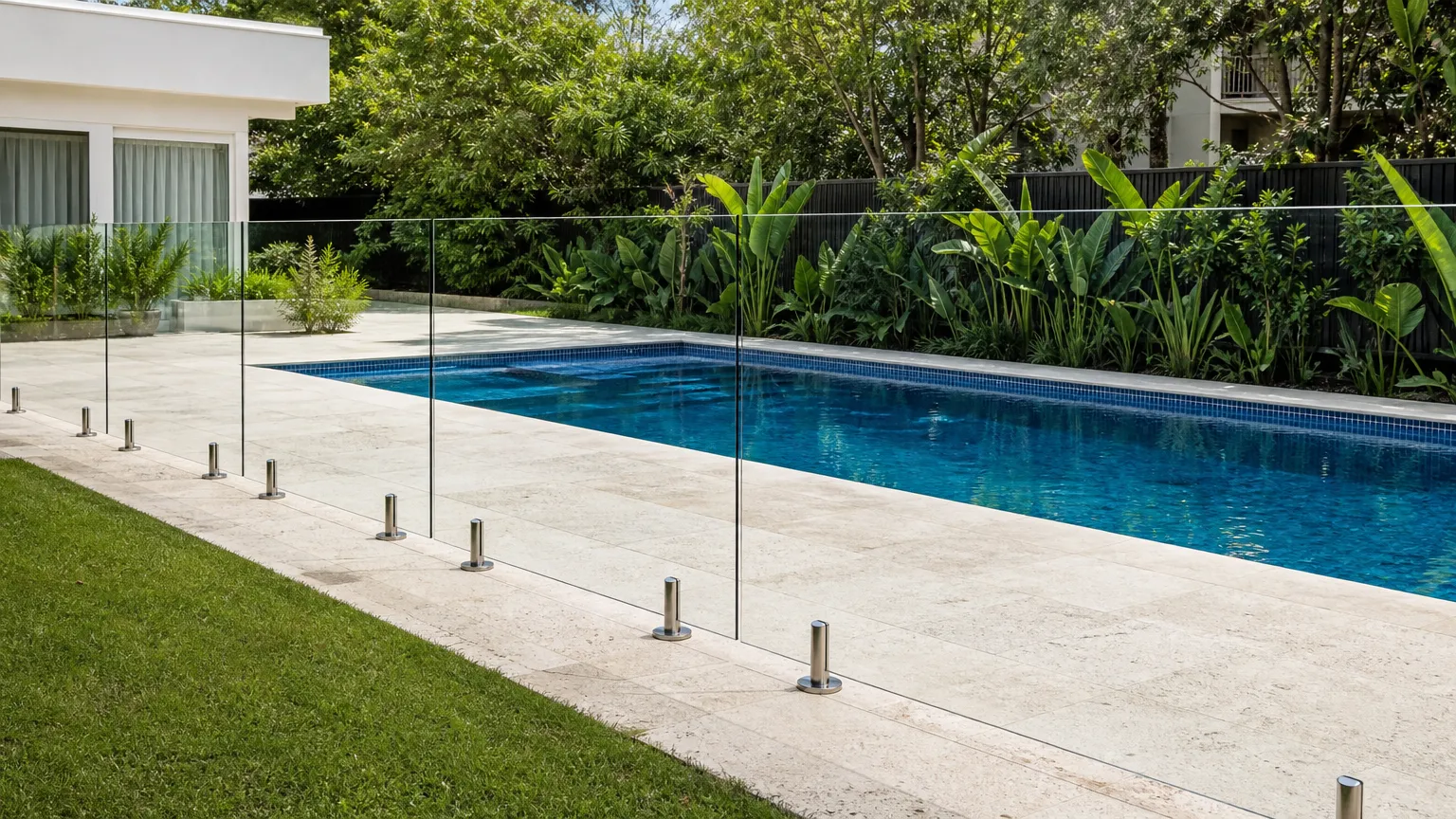
Two frameless fences can use the same glass and still look nothing alike. One sits on core-drilled spigots in a sandstone coping and seems to rise straight out of the stone. The other sits on bolted base plates in a polished finish beside dark tiles, and reads as a row of bright metal squares. The glass is identical. Most of the design work is in everything around it.
This guide goes through those choices in the order an installer will ask about them. For the product itself, see frameless fencing.
The fixing sets the look
How each spigot meets the ground changes the fence more than anything else. A core-drilled spigot goes into a hole cut in the slab or stone, so only the slim post shows. A base-plate spigot bolts to the surface and leaves a plate on show at every fixing. Side-fixed standoffs bolt to the face of a slab or raised edge, so the glass hangs off the side and the walking surface stays clear.
Ways to hold the glass
- Core-drilled spigot
- Set into concrete or stone. Cleanest look, very rigid
- Base-plate spigot
- Bolted to the surface. Quicker, plate visible
- Channel
- Continuous aluminium channel, surface or recessed
- Standoff
- Bolted to the slab face or stringer. Keeps the floor clear
- Posts
- Slim aluminium posts between panels (semi-frameless)
Source · Common Australian systems
The choice is often made for you by what’s underneath. Solid concrete and thick stone take a core drill well. Pavers laid on sand, thin tiles over waterproofing and timber decks usually don’t, and suit base plates or another fixing. Price moves with the method. Yakka Labour’s guide (1 October 2026, incl. GST) puts frameless 12 mm glass at $400 to $700 a metre on core-drilled spigots, $420 to $750 on base plates and $550 to $900 on side-fixed standoffs, with Sydney near the top of each range.
Spigot finishes
Satin stainless is the safe default. It’s a soft, brushed metal that hides fingerprints and water marks, and it sits quietly next to most stone and timber. Polished stainless is brighter and reads more as a feature, but it shows every splash and handprint. Black spigots suit houses with black window frames and dark pool tiles, where they tend to disappear against the surface.
Pick the finish to match what’s already there, which usually means the window frames, the outdoor tapware and the gate hardware. Then use it everywhere, hinges and latch included. On the coast or around a saltwater pool, ask what grade of metal the fittings are made from. A finish only lasts as long as the metal under it.
Where the joints fall
A frameless fence is a run of panels with small gaps between them, and the layout decides where those gaps land. A good layout lines the joints up with something, such as the centre of a step, the edge of a window or the corner of the coping, so the fence looks planned rather than filled in. Odd lengths are taken up with custom panels made to measure, which is better than ending a run on a narrow sliver of glass.
Ask to see the layout drawn out with each panel width marked before anything is ordered. That’s the moment to move a joint out of the middle of the view from the living room, or to slide the gate one panel along.
Put the gate where people walk
People take the shortest path from the back door to the water. Put the gate on that path and it gets used properly. Put it at the far end of a run and before long someone props it open.
The gate has to be self-closing and self-latching and swing away from the pool, and latch height and shielding are set by AS 1926.1. That decides the hardware, so choose a finish from the pool-rated range rather than picking a nice latch and hoping it passes. A frameless glass gate also costs more than a metre of fence. Yakka Labour lists $900 to $1,800 for one (1 October 2026), against $450 to $900 for a semi-frameless or aluminium gate.
Clear or tinted
Clear glass is what most people want, and it keeps the water in view from the house, which helps with supervision. A light grey or bronze tint cuts the glare off a west-facing pool and gives a little privacy while keeping the view. Frosted or heavily obscured glass is the privacy option, but it hides the pool from whoever is meant to be watching it, so talk it over with your council or a certifier before choosing it for a pool barrier. Whatever the tint, every panel must still be toughened safety glass with its permanent safety mark.
Gardens, lights and the climbable zone
The non-climbable zone catches more garden designs than any other rule. It’s a 900 mm arc outside the fence measured from the top of the barrier, plus 300 mm inside, and nothing climbable can sit in it. That rules out planter boxes, built-in seats, boulders, raised beds and retaining walls hard against the glass.
NSW pool barrier
- Minimum height
- 1200 mm from finished ground level
- Gap under the barrier
- 100 mm or less
- Gaps between uprights
- 100 mm or less
- Non-climbable zone
- 900 mm arc outside, plus 300 mm inside
- Boundary fence as barrier
- 1800 mm high
- Gate
- Self-closing, self-latching, opens away from the pool
- Standard
- AS 1926.1-2012 for pools built after 1 May 2013 and any modified barrier
Source · NSW Government, Pool owner obligations
Low planting set back from the fence, or ground covers that stay flat, work well. Lighting is simplest in the ground or on a wall. Anything clamped or drilled into the glass changes the panel and can become a foothold, so agree it with your installer before you buy it.
If there’s a deck or terrace as well
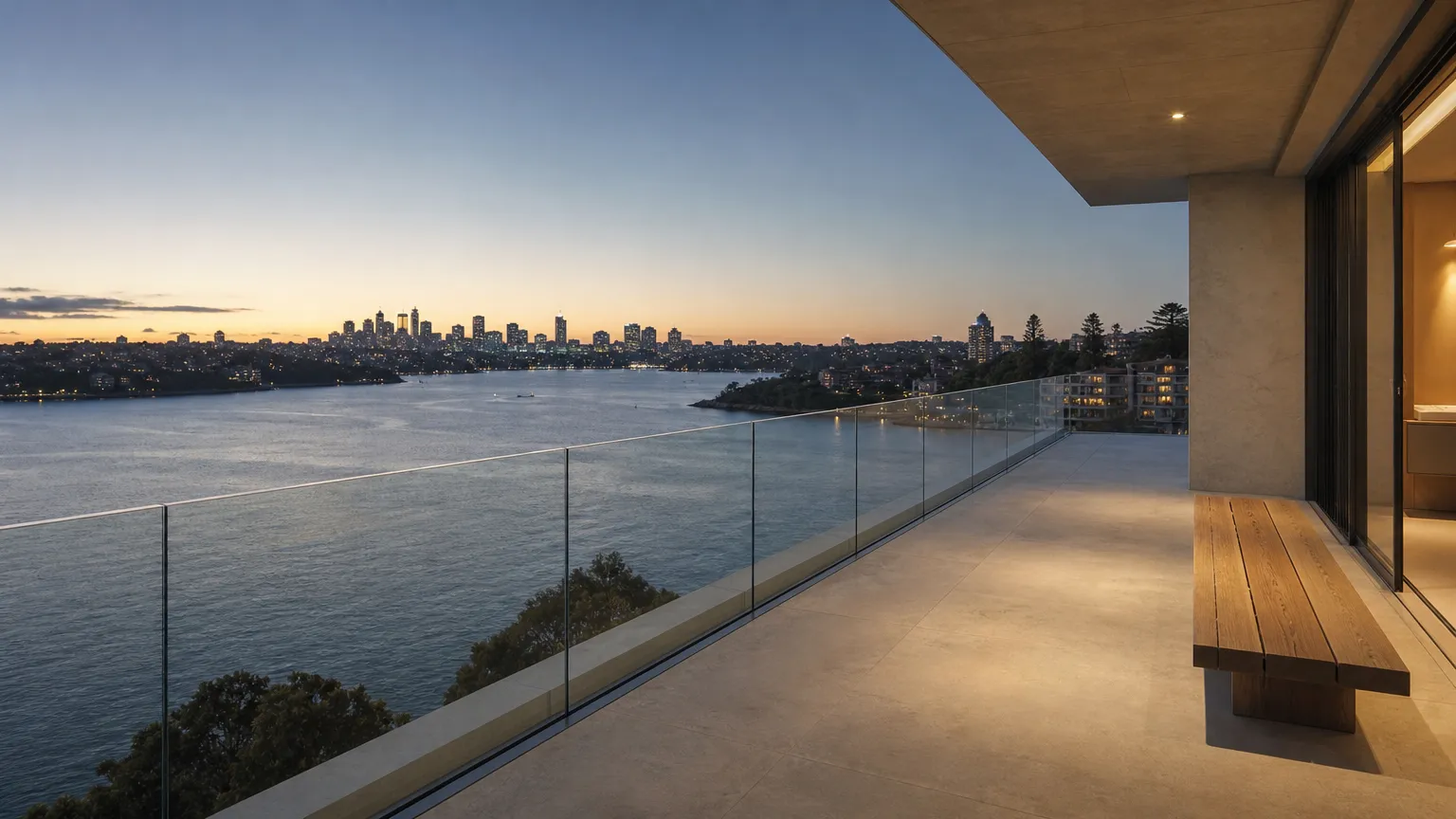
Raised decks, stairs and terraces near the pool need a balustrade, and that follows the NCC rather than the pool barrier rules. You can still use the same glass, tint and spigot finish on both, so the two read as one piece. The glass balustrades page covers that side, and what is a balustrade explains the terms.
What to bring to a quote
Bring a photo of the pool area taken from the house, a note of the surface the fence will fix into, the finish you like, where the gate should go and which way it swings, and any planting or lighting plans near the fence line. Confirm the layout with your council or a certifier, then send it through the free quote form.