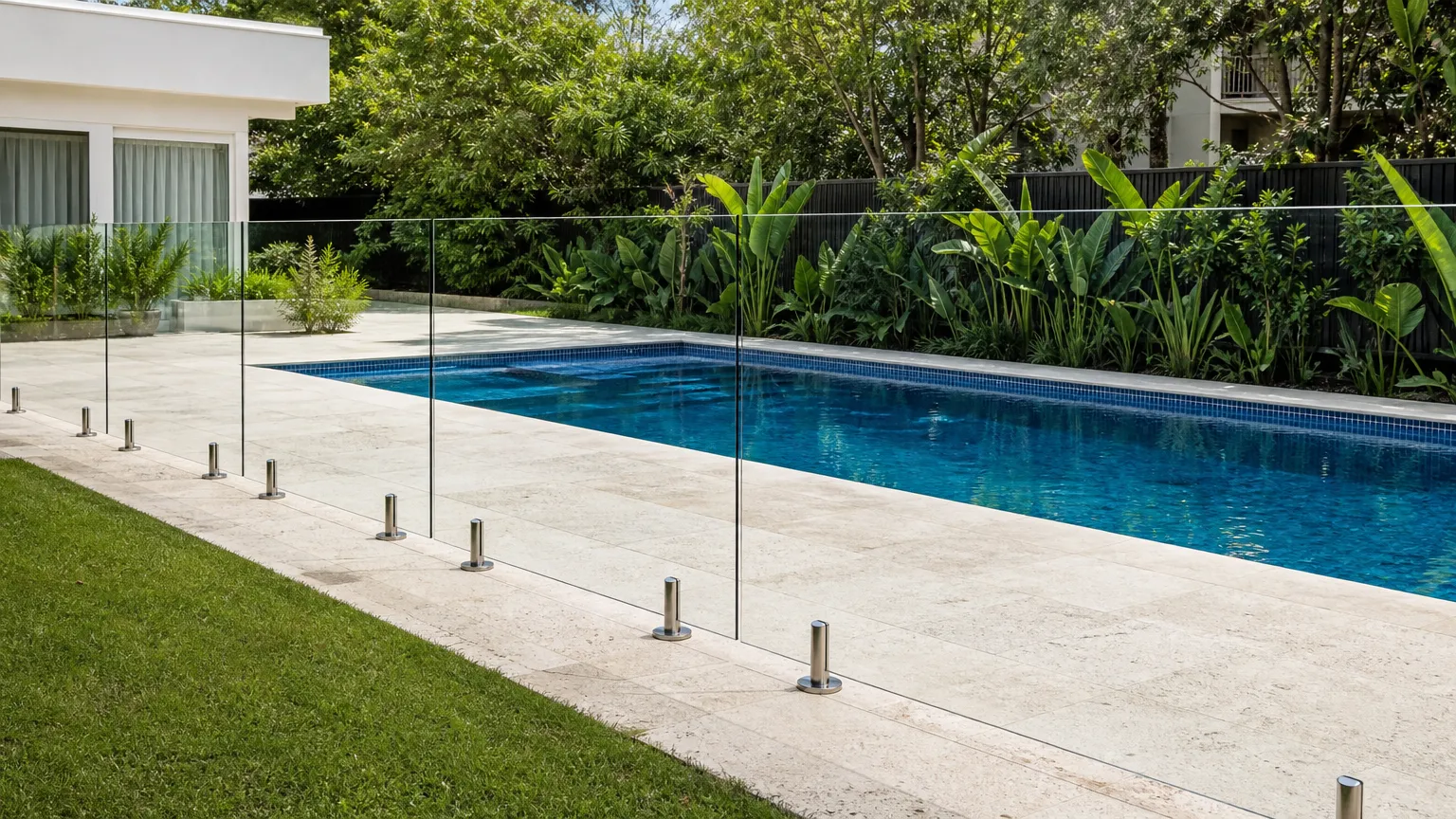
How glass pool fencing works
A glass pool fence is a run of toughened safety-glass panels, usually 12 mm thick in frameless systems, set at least 1200 mm high around the pool. Each panel has a permanent safety mark. There are three ways to hold the glass:
| System | How the glass is held | Best for | Look |
|---|---|---|---|
| Frameless, spigot | Short stainless-steel or aluminium spigots, core-drilled into concrete or stone, or bolted on base plates | Paved or concrete surrounds where you want the clearest view | Just glass and small spigots |
| Frameless, channel | A continuous aluminium channel set into the ground or slab | New builds and renovations where the channel can be recessed | Glass appears to rise from the ground |
| Semi-frameless | Slim aluminium posts between the panels, usually without a top rail | Lawn edges, sloping sites and tighter budgets | Slim posts every panel or two |
Gates are made of the same glass, hung on glass-to-glass or glass-to-post hinges. They must be self-closing and self-latching, and they must open away from the pool.
See the details: frameless pool fencing · semi-frameless pool fencing · DIY pool fence kits.
NSW pool fence rules at a glance
NSW pool barriers are governed by the Swimming Pools Act 1992 and the Australian Standard that applies to your pool. The table summarises the NSW Government’s guidance for pool owners:
| Requirement | What NSW guidance says |
|---|---|
| Minimum height | 1.2 m from finished ground level |
| Gap under the barrier | No more than 10 cm (100 mm) |
| Gaps between vertical members | No more than 10 cm |
| Boundary fence used as pool barrier | 1.8 m high |
| Non-climbable zone | 90 cm arc from the top of the barrier on the outside, plus 30 cm inside |
| Gates | Self-closing, self-latching, opening away from the pool |
| Registration | Every pool and spa must be on the NSW Swimming Pool Register |
| CPR sign | Required near the pool, readable from 3 m |
Which standard applies? It depends on your pool’s construction date. AS 1926-1986 applies to pools built before 30 August 2008, AS 1926.1-2007 to those built from 1 September 2008 to 30 April 2013, and AS 1926.1-2012 to anything newer. If you replace or alter the fence, the barrier must meet AS 1926.1-2012. This often catches people who swap an old aluminium fence for glass.
This is general guidance. Your council or a pool safety certifier can confirm exactly what applies to your property.
The non-climbable zone is where most fences fail
Glass itself is hard to climb. Fences usually fail because of what’s next to them: a pot plant, a retaining wall, a pool pump cover, a garden tap, or a tree branch inside the 900 mm arc on the outside of the fence. Plan the fence line and the landscaping together, and leave the outside zone clear.
What glass pool fencing costs in Sydney (2026)
These are third-party published ranges. Your quote depends on the site.
| Item | Published range (installed, per metre unless noted) | Source |
|---|---|---|
| Frameless, core-drilled spigots | $400–$700 | Yakka Labour, Oct 2026 |
| Frameless, base-plate spigots | $420–$750 | Yakka Labour, Oct 2026 |
| Frameless, side-fixed standoffs | $550–$900 | Yakka Labour, Oct 2026 |
| Frameless (all types) | $430–$600 | Service.com.au, Apr 2026 |
| Semi-frameless with aluminium posts | $280–$450 | Yakka Labour, Oct 2026 |
| Frameless glass gate (each) | $900–$1,800 | Yakka Labour, Oct 2026 |
| DIY kit, supply only | from about $205–$225 | Glassfit Australia, Oct 2026 |
Yakka Labour notes that Sydney prices tend to sit at the higher end of each range. What pushes a quote up or down:
- Ground surface: core-drilling stone or thick concrete takes longer than fixing base plates. Lawn edges usually need a footing or a semi-frameless system.
- Levels and slopes: stepped or raked panels and custom sizes add cost and lead time.
- Gates: every gate adds hinges, a latch and setting-out time.
- Hardware grade: 2205 duplex stainless steel resists corrosion better near salt water and on coastal sites from Manly to Cronulla.
- Access: carrying 12 mm panels through a narrow side passage or up stairs adds labour.
- Removal: taking out an old fence and patching the pavers.
Choosing the right fence for your yard
- Paved surround, want the view: frameless on core-drilled spigots.
- Pool sits on a lawn or slope: semi-frameless, or frameless on footings with a base-plate spigot.
- Elevated pool or deck edge: side-fixed (standoff) glass keeps the deck clear, but it needs engineering for the fall height.
- Pool doubles as a boundary: the boundary section must be 1.8 m high, and that changes the panel choice. Plan it early.
- Confident DIYer: a DIY kit saves labour. You still need it to comply and to be inspected.
How a glass pool fence project runs
- Quote and site check: fence line, levels, ground surface, gate positions and access.
- Measure: standard panels where possible, custom-cut glass where the layout needs it.
- Order: custom toughened glass has a manufacturing lead time, so book well before summer.
- Install: spigots or channel fixed, panels set and plumbed, gate hung and the latch adjusted.
- Check: gate self-closes and latches from any position, gaps are 100 mm or less, and the NCZ is clear.
- Certify if needed: you need a certificate of compliance to sell or lease, and some councils inspect.
Where we install
We quote glass pool fencing across Sydney and up to about 50 km out, including the Northern Beaches, Mosman, the upper North Shore including St Ives, the Eastern Suburbs, the Inner West, St George, the Sutherland Shire including Cronulla, the Hills District, and Parramatta and the west.
Related
Frameless pool fencing
Frameless glass pool fencing in Sydney. Core-drilled and base-plate spigots, channel systems, glass gates, hardware grades and 2026 cost per metre.
Semi-frameless pool fencing
Semi-frameless glass pool fencing in Sydney: glass panels between slim aluminium posts. Where it suits, how it compares with frameless, and 2026 costs.
DIY pool fence kits
Thinking of a DIY glass pool fence kit in Sydney? What a kit includes, 2026 supply-only prices, the NSW rules you must still meet, and when to get help.
Glass pool fencing: your questions answered
Straight answers on glass pool fencing in NSW: how it works, glass thickness, cleaning, durability, gaps, gates, rules and sourced cost ranges.
Is glass pool fencing safe?
How toughened safety glass breaks, what NSW barrier rules require, how gates and climbability compare, and the checks that keep a glass pool fence safe.
Northern Beaches
Glass pool fencing on the Northern Beaches, from Manly and Dee Why to Avalon and Palm Beach. Coastal hardware, sloping sites, bushfire areas and council rules.
Frequently asked questions
How much does glass pool fencing cost per metre in Sydney?
Published 2026 cost guides put installed frameless glass at about $400–$750 per metre (Yakka Labour, October 2026) or $430–$600 (Service.com.au, April 2026). Semi-frameless runs about $280–$450 per metre. Gates are priced separately, from about $400 up to $1,800 for a frameless glass gate. Sydney tends to sit at the upper end of these ranges.
What height does a glass pool fence need to be in NSW?
At least 1.2 m (1200 mm) from finished ground level, with no more than a 100 mm gap at the bottom. If a boundary fence forms part of the pool barrier, it needs to be 1.8 m high. That's according to NSW Government pool owner guidance.
Which Australian Standard applies to my pool fence?
It depends on when the pool was built. NSW applies AS 1926-1986 to pools built before 30 August 2008, AS 1926.1-2007 to pools built from 1 September 2008 to 30 April 2013, and AS 1926.1-2012 to pools built after 1 May 2013. If you modify or replace the barrier, AS 1926.1-2012 applies and earlier exemptions end.
Is frameless or semi-frameless glass better for a pool?
Frameless gives the clearest view and the most minimal look, but it costs more and needs a solid base for the spigots. Semi-frameless uses slim posts between the panels. It's usually cheaper and more forgiving on uneven ground or sloping sites. Both can be fully compliant.
Do I need council approval for a glass pool fence?
A new pool barrier is generally covered by the approval for the pool itself. Replacing a like-for-like fence may not need a separate approval, but the new barrier must still comply with AS 1926.1-2012. Check with your council or a private certifier before you start, especially on heritage, bushfire or waterfront lots.
How long does a glass pool fence installation take?
Once the glass arrives, a typical backyard pool takes one to three days to install, depending on the length, the ground surface and the number of gates. Custom-cut panels for odd angles or slopes add manufacturing lead time, so allow more time before summer.